
The Rise of Smart Telescopes
What Makes a Telescope Smart
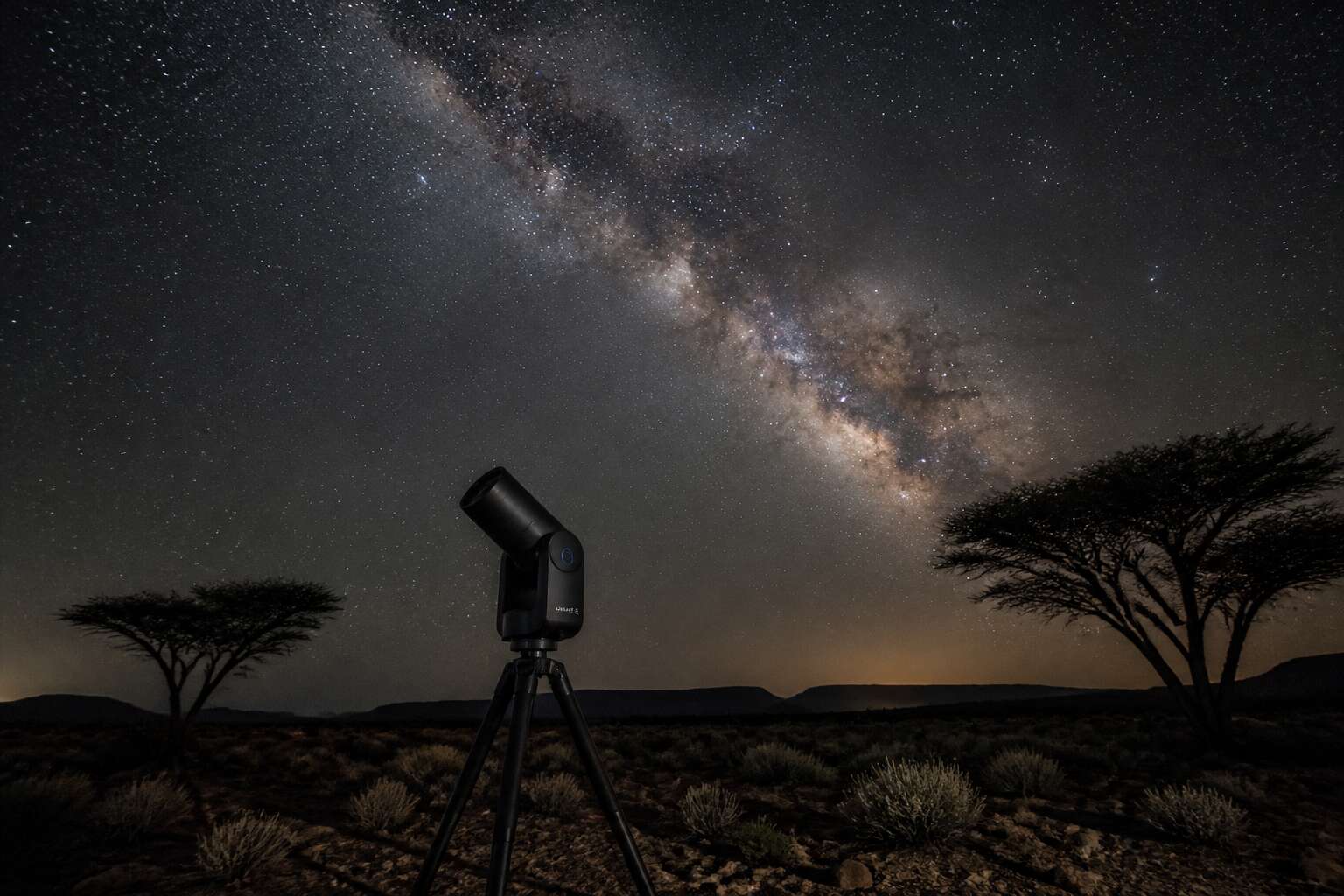
The night sky no longer demands years of practice. Smart telescopes automate the core tasks of astronomy. For South African observers, the dwarf 2 smart telescope south africa offers a compact and portable solution.
What makes a telescope smart? It is the combination of onboard computing with precise optics. The device identifies objects automatically and tracks them without manual effort. This removes the difficult alignment process of traditional equipment.
- Automated star recognition using internal databases
- Continuous gimbal tracking to counter Earth’s rotation
- App based control via WiFi or Bluetooth
- Onboard image processing for clearer results
These capabilities prove useful under southern skies. I appreciate how the device adjusts exposure according to ambient light, working well in both city suburbs and remote Karoo sites. It brings deep sky imaging within reach of more people!
A Brief Look at the Dwarf 2’s Predecessors
The first smart telescopes were intelligent in concept but awkward in practice. They required external computers, complicated power supplies, and a patient operator. These predecessors established the foundation, yet they never left the observatory. A decade ago, carrying one in a backpack seemed impossible.
The shift came in identifiable stages:
1. Autoguiders made tracking precise without manual adjustment.
2. Integrated star databases removed the need for paper charts.
3. App based control finally eliminated laptop tethers.
Each stage brought the technology closer to the compact dwarf 2 smart telescope south africa. I have used several of those early models, and each one taught me patience. Their limitations drove the engineering that now makes deep sky imaging effortless.
Why Astrophotography Is Becoming Accessible
Eighty percent of South Africans live under skies polluted by streetlights and security beams. That statistic used to mean astrophotography was reserved for remote farms. The dwarf 2 smart telescope south africa changed that calculation.
The rise of smart telescopes came from solving practical problems. Three shifts stand out:
- Entry level prices dropped below the cost of a midrange phone.
- Free mobile apps replaced expensive desktop processing.
- Online communities shared settings and targets instantly.
I watched a friend in Pretoria capture the Southern Pinwheel Galaxy on her first night. No collimation, no polar alignment, no tears. The hobby moved from precision engineering to pure curiosity. Astronomy no longer punishes inexperience. It is simply a hobby that works.
Comparing Smart Telescopes with Traditional Models
The comparison between traditional and smart telescopes comes down to patience versus immediacy. A conventional rig demands mastery of mount setup, eyepiece selection, and tracking calibration. A smart telescope like the dwarf 2 smart telescope south africa handles those layers internally, leaving the observer free to explore.
Consider the physical weight alone. Traditional telescopes for deep sky work often require:
- counterweights
- dovetail plates
- a sturdy tripod
I have carried such setups across fields and regretted every kilogram. The dwarf 2 smart telescope south africa weighs under a kilogram and fits into a backpack. That difference changes how often the equipment leaves the house.
Observational habits also diverge. With a traditional instrument, you look through the eyepiece and record what you see. With a smart telescope, you let the sensor accumulate photons and then examine the resulting image on a screen. The latter removes the learning curve of visual astronomy entirely.
Dwarf 2 Features That Matter
Optical Performance and Focal Length
After a few nights imaging from my backyard in Gauteng, I can say the dwarf 2 smart telescope south africa delivers optical performance that surprises many first time users. Its 150mm focal length and 24mm aperture strike a balance between reach and portability, suited for deep sky targets that climb high in our winter months.
What matters most in practice:
- The built in dual-band filter isolates hydrogen alpha and oxygen III emissions
- Focal length determines how much of a nebula fills the frame
- Sharpness holds across the entire field, even at the corners
That combination frames objects like the Carina Nebula without a guiding setup, a genuine advantage for anyone imaging from suburban Johannesburg or a dark spot near Sutherland. The value lies in consistency across sessions, and that consistency is hard to beat!
Built-in Image Processing and Stacking
Most telescopes capture light. The dwarf 2 smart telescope south africa captures light and immediately transforms it. Each frame the sensor records is aligned with the previous one, stacked in real time, and refined by the onboard processor. The image on your screen deepens as you watch!
I have spent enough nights under South African skies to appreciate what this means. Stacking was once the most tedious part of astrophotography. It required calibration frames, dedicated software, and hours of manual correction. The dwarf 2 removes that entire workflow. It performs the processing internally, so the observer never touches a computer.
The built-in processing provides specific benefits:
– Live stacking without a laptop, even at a remote dark site
– Instant feedback on framing and exposure quality
– A streamlined workflow that prioritises observation
For anyone using a dwarf 2 smart telescope south africa, this automation changes the relationship with the night sky. You engage with the image, not the machinery.
Portability and Battery Life
The dwarf 2 smart telescope south africa fits inside a small backpack. The carrying case holds the telescope, the tripod, and every cable you might need. You walk from the vehicle to a dark clearing. The total weight stays manageable, even over uneven terrain. This matters when the best sky is a kilometre away.
Battery life keeps pace with long nights. A single charge powers the sensor, the onboard processor, and the tracking motors for hours. You can watch the sky from early dusk until midnight without searching for a power outlet. No generator, no extension cord, no tangled cables at the base of the tripod. The dwarf 2 smart telescope south africa simply runs. The darkness becomes the only thing you need to bring.
App Integration and Control
The average person glances at their phone 80 times a day. For astrophotographers in South Africa, that device becomes the sole interface with the night sky. The dwarf 2 smart telescope south africa places its entire operation inside the companion app. You align the mount, select a target, and start capture from the same screen. The live view mirrors the sensor output.
A thoughtful layout saves you from reading manuals by torchlight. The app performs plate solving automatically and marks the exact framing. It flags sky conditions and alerts you before a long exposure. The controls translate directly into action:
- Tap a catalogue entry to slew the telescope
- Adjust gain and exposure with a swipe
- Inspect the stacked image on your phone
The dwarf 2 smart telescope south africa turns the object in your pocket into the single most useful piece of astronomy kit you own.
Field of View and Astrophotography Capabilities
The field of view on the dwarf 2 smart telescope south africa stretches across 28 arcminutes, wide enough to frame the Orion Nebula in full while leaving breathing room around the edges. That wider window changes how you approach a session. You can capture sprawling nebulae or tightly packed galaxy groups in a single frame, then pinch into the stacked result to inspect the fine thread of a spiral arm.
Consider the scenes this unit handles without breaking a sweat:
– The complete Andromeda Galaxy core with dust lanes resolved
– A full lunar disc with crater floors visible at the terminator
– A comet sliding through a star field over a 40 minute capture
The dwarf 2 smart telescope south africa puts that capability into a package small enough to balance on a garden wall in Durban or a camp table in the Kgalagadi.
Observing the Southern Sky with Dwarf 2
Must-See Southern Constellations and Targets
From a Karoo farmstead or a Cape Town suburb, the southern celestial hemisphere rewards those who simply look up. The dwarf 2 smart telescope south africa users discover that Crux, the smallest constellation, holds the Coalsack Nebula, a dark rift that needs no filters to impress. Nearby, the Eta Carinae Nebula erupts in layered pink and violet clouds.
Omega Centauri rises like a swarm of ancient suns, ten million stars packed into a globe that dwarfs our own galactic neighbourhood. The Large Magellanic Cloud offers the Tarantula Nebula, a stellar nursery so vast it would stretch across several full moons.
- Jewel Box cluster, a scatter of blue and orange gems
- 47 Tucanae, a globular cluster visible to the naked eye
- The Southern Pinwheel Galaxy, a face-on spiral
These targets sit high in South African skies, and the dwarf 2 captures their light with a patience that mirrors the night itself.
Light Pollution Challenges in Local Cities
City skies demand more from a telescope. In Pretoria or Durban, the glow dome swallows the faintest clusters, and the dwarf 2 smart telescope south africa must work harder to isolate starlight from scattered urban light.
The challenge is contrast, not alignment. A Bortle class 7 sky reduces the effective aperture of any telescope. Urban observers gain more from travelling 60 kilometres to a dark site than from upgrading equipment.
- Security floodlights wash out wide field targets
- Clouds push city glow back down toward the observer
- Streetlight scatter leaks into long exposures
Yet the dwarf 2 smart telescope south africa still delivers. It stacks dozens of short frames, and those frames carry more urban noise than rural ones. The rejection algorithms discard the worst outliers, revealing detail that would remain hidden through a manual eyepiece.
Best Viewing Sites Across South Africa
For many South African observers, the finest views arrive after a long drive. The dwarf 2 smart telescope south africa rewards those who reach the Karoo’s interior, where the sky behaves differently. At Sutherland, winter nights bring the Milky Way core overhead, and the wide field picks out the Lagoon Nebula without the orange haze found near cities. At a Fraserburg farm, I watched frames stack and reveal the Jewel Box cluster.
These sites share altitude and dry air. They sit away from coastal clouds and municipal light. Good options include:
- Sutherland, where SALT signals serious astronomy
- The Tankwa Karoo, with uninterrupted horizons
- Augrabies, where granite frames the southern sky
- The Baviaanskloof, isolated from Eastern Cape glow
One night at any of these places makes the equipment feel secondary. The dwarf 2 smart telescope south africa keeps pace, stacking frame after frame until the detail settles into view.
Buying and Importing Dwarf 2 into South Africa
Understanding South African Customs and Duties
When ordering a Dwarf 2 from overseas, the real cost only appears at the border. South African customs applies import VAT of 15% plus a duty rate depending on the product classification. The dwarf 2 smart telescope South Africa buyer must also account for courier handling fees, which often catch people off guard. I have seen the final bill jump by nearly a third.
Many local retailers now stock this device, but buying directly from the manufacturer can still be cheaper. You need a clear picture of the total landed cost before committing. That means checking the current SARS tariff code and asking the seller for the correct HS code.
Items that typically trigger extra charges:
- Shipping insurance added to the declared value
- Customs clearing agent fees
- Storage fees if the parcel waits at the depot
The process is straightforward once you know these steps. The dwarf 2 smart telescope South Africa market has grown enough that some suppliers offer local warranties, which changes the purchase decision entirely.
Authorised Dealers vs. International Shipping
The smart telescope’s popularity has created a peculiar dilemma for South African buyers. The dwarf 2 smart telescope south africa can be purchased through authorised dealers or imported directly, and each route attracts a different kind of buyer. Local dealers offer warranties and personal support. International shipping offers lower prices, yet it means longer waits and potential complications.
In my experience, the choice comes down to temperament as much as budget. Consider what matters to you:
- Speed of delivery and after-sales service
- Warranty coverage and repair logistics
- Return policies if the unit arrives faulty
The local market now has enough authorised dealers that buyers can compare options without leaving the country. Some shoppers still prefer the manufacturer’s direct route. Both choices work, but they serve different temperaments.
Warranty and After-Sales Support
Warranty support is where the dwarf 2 smart telescope south africa reveals its true cost. Imported units often carry a manufacturer’s warranty, but returning one to China for repair takes weeks. Local authorised dealers handle faults in Johannesburg or Cape Town, but their prices reflect that convenience. In my experience, the first fault decides which route you should have chosen.
- Shipping costs for repairs are yours to carry.
- Local repairs have a turnaround of five working days.
- Imported units may require courier fees exceeding R2000.
The warranty period remains the same, yet the practical value differs. A replaced circuit board loses you a month of clear winter skies. That is the real price of a bargain.
Currency and Pricing Considerations
Foreign exchange rates are the silent tax on every imported telescope. The rand’s volatility can add hundreds to your purchase before it even lands. One week you are quoted R14,500, the next week the same unit costs R15,800. This fluctuation is a gamble only the patient should take.
The listed price online is never the final figure. Payment processors add their own conversion margins, often invisible until the statement arrives. A quote in dollars can shift dramatically between the moment you click and the moment the bank clears the transaction. Currency risk is a real cost, not a footnote.
Consider the true price of a dwarf 2 smart telescope south africa when secured through international channels. The savings are often measured in the gap between the dealer markup and the shipping fee.
– Global pricing excludes VAT, which customs will demand upon arrival.
– Exchange rates move daily, making budget planning difficult.
– International credit card fees add between two and three percent to the total.
– A parcel stuck in customs is a headache for the buyer to resolve.
The alternative is buying locally at a fixed rand price. It is a difference of a few thousand, but the price is set. No surprise fees. No waiting for a favourable exchange rate. With a local purchase, you know the total cost before you commit, a rare luxury in this hobby. The imported route is for the risk taker who values the savings over the security of a stable transaction.
I have seen the total cost of a dwarf 2 smart telescope south africa rise by twelve percent in three days due to a weak rand. That is a painful premium for patience. The margin between a bargain and a burden is often a single exchange rate announcement. Your wallet decides which side you stand on.
Delivery Times and Tracking Options
The courier’s flight path matters more than the distance. A parcel from Hong Kong to OR Tambo can take four days. The same parcel from Singapore takes sixteen. The route determines the delay.
Tracking a dwarf 2 smart telescope south africa is rarely linear. Consider these typical delivery windows:
– Express air: seven to ten business days
– Standard air: fourteen to twenty-one days
– Economy sea: six weeks or more
Your tracking number tells you where the parcel is, not when it will arrive! The status updates lag behind reality. I have seen a dwarf 2 smart telescope south africa marked as “in transit” for a week while it sat in a sorting facility. The tracking system is a guide, not a promise.
Avoiding Counterfeit or Grey-Market Units
Anyone searching for a dwarf 2 smart telescope south africa should know that the market is not always transparent. Grey-market imports tempt with lower prices, but they arrive stripped of regional firmware and the correct power adapter. The warranty is void. I have watched buyers learn this only after the box is already empty and the seller has vanished from the chat app.
Authorised channels exist for the dwarf 2 smart telescope south africa. They handle local support, genuine firmware updates, and real returns. Counterfeit units are worse. They mimic the casing while hiding inferior sensors behind a plastic lens. The image quality collapses under a dark sky. The app struggles to connect. The telescope becomes an expensive ornament.
The difference between a genuine unit and a fake is not always visible in the product photos. It becomes visible in the first night of observing, when the stars refuse to sharpen and the colours run wrong. That night arrives quickly for too many buyers.
Maximising Your Dwarf 2 Experience
Setting Up for the First Time
The first night with your dwarf 2 smart telescope south africa demands patience. The unit arrives in a compact case, but the real work begins after sunset. You will need to level the tripod and connect the app before the sky fully darkens. The alignment process takes roughly ten minutes.
Southern hemisphere skies rotate in a way that confuses newcomers. The Dwarf 2’s star tracker handles this, but only if you calibrate the compass correctly. A misaligned unit will drift and frustrate.
- Charge the battery fully before your first outing.
- Update the firmware while connected to Wi-Fi at home.
- Place the unit on stable ground, away from vibration.
The dwarf 2 smart telescope south africa rewards those who respect its limitations. Give it a clean horizon and a steady surface, and it will reveal the Magellanic Clouds with unsettling clarity.
Essential Accessories for Local Conditions
After three weeks with the unit, I stopped being surprised by what the dwarf 2 smart telescope south africa can do. Load shedding schedules dictate when the sky is darkest. No internal battery survives an entire evening if the companion app stays connected to your phone. I pack a 30 000 mAh power bank and a short USB-C cable. The short cable matters because the original one loses contact when the first drop of dew forms.
A red LED headlamp earns its place in the bag for a second reason. The southern sky rotates without mercy, but your pupils should not. Dim red light lets you check the compass and clean the lens without destroying night vision. For dust, a permanent resident in the Karoo, a blower brush from a camera shop clears the glass before each session. The dwarf 2 smart telescope south africa rewards a photographer who treats cleaning as part of the ritual.
Joining Local Astronomy Communities
One evening under the Karoo sky, a stranger pointed out a satellite crossing the Large Magellanic Cloud. That moment came from joining a local astronomy group, not from any manual. The dwarf 2 smart telescope south africa performs well alone, but the experience deepens when shared.
Local clubs from Cape Town to Johannesburg hold regular observing sessions. Members test each other’s setups, compare stacking settings, and warn about incoming weather. They know which farms offer the clearest horizons.
– Star parties at dark sky reserves
– Shared knowledge of southern hemisphere targets
– Group outings timed to new moons
The unit becomes a gateway to these networks. Strangers become collaborators, and every session teaches something new.
Troubleshooting Common Issues
Even reliable equipment occasionally refuses to cooperate. The dwarf 2 smart telescope south africa delivers steady results, yet certain issues surface at inconvenient times. A common complaint involves the auto-focus motor stalling on cold Karoo nights. Restarting the unit usually resolves it, but tightening the focuser ring beforehand prevents the problem entirely.
– WiFi drops during stacking
– Battery drain accelerated by continuous cooling
– Blurry frames caused by a dusty lens
Battery drain surprises many users. The internal battery handles one session comfortably, but cold temperatures reduce capacity. Carry a power bank. WiFi issues trace to interference from nearby devices. Switch to 5 GHz or enable airplane mode on your phone.
Perform a quick calibration before each outing. This minimises frustration under the southern sky.


0 Comments