
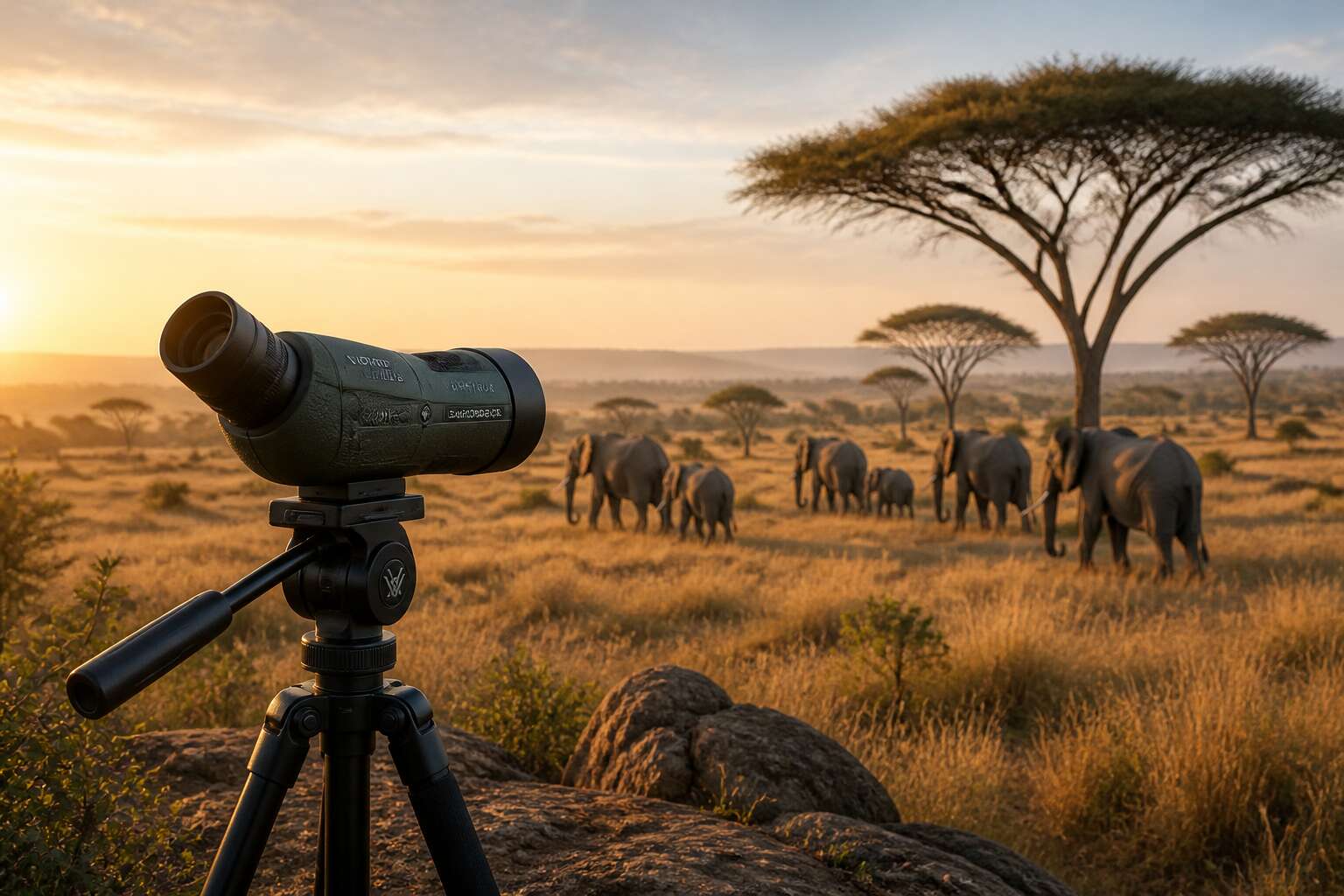
Assessing the Viewing Conditions Across South African Landscapes
Bushveld versus open grassland: matching magnification to terrain
The difference between a lilac breasted roller in mopane bush and a springbok on the open flats is a matter of perspective, and magnification! In dense bushveld, branches crisscross every sightline, so a lower power like 8x keeps a broad field of view. The same compact travel scope south africa can feel underpowered when you scan treeless grassland.
Open terrain rewards a more detailed view. A 12x to 15x magnification pulls distant herds into crisp relief, but it amplifies hand shake and heat shimmer. The biome dictates your choice before you lift the scope.
The two biomes demand different things from the optics:
- Bushveld light filters through leaves, softening contrast and demanding a wide aperture.
- Grassland glare bounces off pale stems, punishing chromatic aberration.
Coastal birding opportunities along the Cape and KwaZulu-Natal shores
The Cape coast hosts over 400 bird species, and the shoreline changes every few kilometres. Along the Western Cape, cold Atlantic water brings African penguins and Cape gannets. In KwaZulu-Natal, warmer Indian Ocean currents attract different seabirds entirely. A compact travel scope south africa fits easily into a daypack while you scramble over rocky headlands.
I use mine to separate a Sandwich Tern from a Common Tern in flight. The scope handles the wind shake surprisingly well! On the KZN coast, mangrove kingfishers sit motionless in the shallows. The Cape’s kelp gull colonies are louder and bolder.
- African penguin at Boulders Beach
- Pink-backed pelican at St Lucia
- Cape cormorant along the Atlantic coast
Each site demands quick focusing and a steady rest.
Big game watching from safari vehicles versus walking safaris
From the elevated seat of a safari vehicle, the horizon wobbles with heat haze. A compact travel scope south africa manages that distortion, but the engine’s vibration demands a firm grip. Walking safaris present a different puzzle. Your eye level drops to the grass, and every twitch of a lion’s ear demands attention. The scope’s light weight matters when you carry it for hours.
Assessing viewing conditions means reading light and wind. Early mornings offer crisp edges. By midday, shimmer ruins detail. For walking, I use a beanbag or a low branch to steady the lens. For vehicles, the roof hatch becomes a natural mount. Neither approach beats the other. They simply ask for different patience.
The impact of harsh midday sunlight on lens performance
The South African sun is a glorious dictator. By 11am it demands tribute from every lens it touches. The theoretical sharpness of a compact travel scope south africa evaporates in the heat shimmers rising from the Kalahari sand. You are not looking at a herd of springbok anymore; you are looking at a watercolour painting having a seizure. That is the moment you learn that midday is for naps, not for birding.
Lens performance under this light undoes most of the engineering work the manufacturer put in. Glare bounces off every surface. The aperture might be wide open, but the dynamic range collapses into white and black soup. I have seen a veteran guide identify a rare raptor by silhouette alone because the scope simply could not resolve detail. Pulling the eyepiece hood closer helps only slightly. The real battle is contrast, and the heat haze always wins.
Certain plains produce worse distortion than others. The Highveld, with its thin air, offers kinder conditions around 4pm. The Limpopo Valley holds moisture like a grudge. A compact travel scope south africa struggles less at lower magnifications. Cranking it up to 30x only magnifies the hot air, not the animal. I keep my settings humble and my expectations humble as well.
- Check the ground temperature first. Hot gravel creates stronger shimmer than wet grass.
- Look for a distant dark object. If its edges wiggle, do not bother raising your binoculars.
- Shade counts as valuable real estate. Position yourself accordingly.
South African weather offers no sympathy for the equipment obsessed. A sudden gust of wind carries dust into the objective lens. The harsh morning glare flattens the colour out of a lilac-breasted roller. The quick worker accepts these losses and looks for partial views. A clear sighting at 20x across a valley will beat a broken view at 40x every single time. So when the sun reaches its peak, I tuck the compact scope into my bag and watch the vultures instead. They see better than I do anyway.
Key Attributes to Evaluate in Lightweight Spotting Optics
Striking the right balance between objective lens size and total weight
There is a threshold where optical gain becomes physical burden. Extra millimetres of objective lens add weight, and your neck registers the strain after an hour of glassing. A 50mm objective captures evening light, but it makes you hesitate before lifting the scope. For a compact travel scope south africa, the calculation is constant. I have tested scopes that gather brilliance yet leave shoulders sore. Sharpness rarely compensates for a bruised collarbone.
The real test happens on a two hour hike, not in a showroom! A 32mm or 40mm objective with a solid body often outperforms a heavier lens you avoid using.
- Total weight under 700 grams, so the scope stays with you.
- Objective size above 42mm only if the tripod remains in the vehicle.
- Focus wheel resistance that matches your gloved fingers.
That is where the decision settles for any compact travel scope south africa.
ED glass and multi-coating for crisp, colour-accurate images
Uncoated glass reflects roughly 4 percent of light per surface. ED glass, or extra-low dispersion, reduces chromatic aberration so a white-fronted bee-eater’s chest does not bleed purple fringes. Multi-coating on every air-to-glass surface ensures that each reflection steals less than one percent of available light. These elements decide whether a compact travel scope south africa rewards you with colour accuracy or a washed-out approximation.
The brand name tells you little. The coating’s hardness matters because field dust abrades soft layers. The number of coated surfaces includes the ocular and prism faces. The ED element’s placement within the optical path influences performance. In my experience, a scope that balances these factors serves well on a two-hour walk.
Weather sealing and nitrogen purging for dusty and rainy conditions
Moisture and dust find every unsealed gap. A compact travel scope south africa endures Karoo grit and Cape rain in a single morning. Weather sealing keeps particles away from the focus mechanism and prism housing. Nitrogen purging removes internal humidity before the unit is sealed, preventing fogging.
I have tested scopes after a season of field abuse. The purged ones kept their clarity. The others showed hazy internal films. O-rings at the eyepiece and objective lens, an IPX7 rating, and argon purging for thermal stability matter more than brand promises.
- Sealed ocular and objective assemblies
- Double O-rings on focus controls
- Argon purging for internal dryness
Your compact travel scope south africa must handle dust and water without hesitation.
Minimum focusing distance for observing small reptiles and insects
A minimum focusing distance of two metres separates a real field scope from a distant viewer. A leopard tortoise lifting its head, a dragonfly holding on a reed, these moments require closeness. My compact travel scope south africa reaches 1.8 metres, letting me study a five centimetre agama fully.
- Parfocal zoom keeps focus from 1.8 metres to infinity
- Fast focus knob, a single half turn from near to far
- Stable close-range field, no hunting
Reptiles and insects do not wait. Catch a skink at two metres, then refocus on a secretary bird. Some eyepieces shift minimum distance at higher magnification. That hidden flaw changes every encounter.
Eye relief and twist-up eyecups for glasses wearers
For anyone who wears glasses, eye relief determines whether a scope works at all. I have watched birders twist their eyecups down only to find the image clipped at the edges. A real field scope needs at least 14 millimetres of eye relief, maintained across the magnification range. This is not a specification to skim past.
Twist-up eyecups should feel positive and click into place. They must stay put when you press your eye against them. The better designs let you adjust in half steps. That flexibility helps when afternoon light changes and you need to move your eye closer or farther.
- Check the eyecup grip with sweaty hands.
- Confirm the adjustment works with gloves.
- Test eye relief at the highest magnification.
A compact travel scope south africa that neglects these details will cause frustration on any outing. After a morning near Porterville, I swapped out a poorly designed model for one with fully adjustable eyecups. Every subsequent hour behind the glass became far more comfortable.
Comparing Popular Compact Scope Styles for Frequent Travelers
Straight versus angled body designs for quick target acquisition
Many travelers overlook how the eyepiece angle affects reaction time. A straight body design aligns naturally when you raise the scope to your eye, which suits quick target acquisition during unexpected animal movements. Angled bodies allow a more comfortable posture when you sit on a rock or vehicle seat, but they require a slight adjustment in wrist position.
A compact travel scope south africa with a straight eyepiece often wins for close-range bush encounters. The learning curve is shorter, and you can track a moving bird or mammal without repositioning your whole body.
- Straight: faster on moving subjects, simpler to use from a standing position.
- Angled: better for long waits, tripod use, and shared viewing among multiple people.
For frequent travelers who value immediate response over ergonomic flexibility, the straight design remains the practical default. Angle seekers still thrive when time allows a stable setup, but not in a suddenly emerging leopard.
Fixed magnification eyepieces versus zoom alternatives
The choice between fixed and zoom magnification is a choice between certainty and possibility. Fixed eyepieces deliver a single, optimised optical path. The image stays consistent across the field, and fewer moving parts reduce failure points on a jolting gravel track. You never fumble with a zoom ring while a lioness disappears into thickets.
- Fixed: lighter, simpler, sharper at one power.
- Zoom: flexible, heavier, slower to settle.
Zoom eyepieces offer flexibility on demand. Widen to locate a bird, tighten for detail. Yet every moving element compromises clarity, and the gap grows as light fades after sunset.
For a compact travel scope south africa, this choice reflects temperament. I lean toward fixed glass, but I understand the appeal of zoom. A fixed eyepiece rewards the observer who trusts one tested setting. A zoom model suits a curious mind, one willing to carry extra weight and accept slower settling times for options.
Full-size power in a pocket-friendly chassis
Most frequent travellers I know pack a scope only if it disappears into a daypack. That simple test filters the market quickly. Monocular formats win on weight, often under 300 grams. Mini spotting scopes offer a broader objective lens for early morning light.
Roof prism construction dominates compact travel scope south africa sales because the body stays slim. Porro prism models, recognisable by offset barrels, cost less and produce a slightly brighter image at the same price point. The difference matters less to a traveller than how the instrument carries day to day:
– Monocular formats suit the minimalist who hikes hands free
– Mini spotters reward travellers who spend long stretches at one viewpoint
A compact travel scope south africa that rides in a daypack gets used. One left in the car boot becomes luggage.
Tripod mounts, monopods, and window clamps for stable viewing
Stability separates a useful optic from a frustrating one. A compact travel scope south africa gives you nothing if every breeze sends the image wobbling. I have seen travellers drop good money on glass, then struggle with handheld blur.
The fix is often simpler than expected. A lightweight tabletop tripod fits in a side pocket and steadies the view for long sessions. A monopod trades support for speed, useful when scanning from a vehicle. Window clamps relocate the scope to a glass edge, perfect for coastal birding stops.
Choose based on your typical posture:
- Tabletop tripod for seated or prone viewing
- Monopod for standing and quick adjustments
- Window clamp for car-based watching
Teamed with a fluid head, these supports multiply what your optic can show.
Rubber armouring and scratch resistance for luggage handling
Frequent flyers know the baggage carousel is a battlefield. A compact travel scope south africa needs more than optical bravado; it needs a skin that shrugs off scrapes. Rubber armouring, often with a pebbled texture, absorbs impacts and provides grip in humid coastal air. Some scopes use a nylon composite shell, lighter but less cushioned against hard knocks.
Compare the tactile feel of a fully armoured body against a partially exposed metal tube. The latter looks elegant but invites dings. For boating trips around the Cape, that rubber layer also deadens the rattle of loose gear. Examine the eyepiece cup and focus wheel too; these protrude and suffer first.
- Fully armoured bodies: superior scratch resistance
- Metal exposed edges: prone to dents
- Recessed controls: protected during baggage throws
A compact travel scope south africa that survives years of handling often has recessed dioptre rings and flush-fitting lens caps. Weight matters, but a few extra grams of protective rubber is a fair trade for a scope that still looks presentable after a week in a duffel.
Budget-conscious models that still deliver strong optical quality
Frequent travelers ask me whether a budget roof prism can match a heavier Porro design for a compact travel scope south africa. Roof prisms slide into a daypack’s side pocket without drama. Porro prisms offer a wider apparent field for less money, but their chunky barrels test zipper limits!
I have handled the 8×25 class from three Chinese brands under R2000. The sharpness differences are marginal. One model impresses with a stiff focus wheel that stays put. Another has a soft twist-up eyecup that holds its position.
- One budget model matches the sharpness of a scope twice its price
- Another sacrifices colour fidelity to shave 50 grams
The real separator is lens coatings. Fully multi-coated models beat single-coated rivals in overcast Cape winters, and the weight difference between these models rarely exceeds 60 grams. Pick the one that feels natural in your palm.
Practical Strategies for Packing and Protecting Your Optics
Choosing the right case, pouches, and protective wraps
A single grain of Karoo dust can etch a lens beyond repair. That reality shapes how I pack my compact travel scope south africa. The right case is your first defence. A hard shell with custom foam absorbs luggage tosses. A soft pouch offers speed but less protection. I use both, depending on the day.
For extra security, wrap the scope in a microfiber cloth before tucking it into its pouch. This prevents scratches from sand trapped inside. I also keep a small desiccant pack in the case to counter coastal humidity. These steps matter more than pricey brands.
My typical carry setup includes:
- A padded hard case for flights
- A lightweight hip pouch for game drives
- A neoprene wrap for quick protection
Managing dust and sand during open-vehicle game drives
Every open vehicle safari has that moment when the wind shifts and you taste grit between your teeth. That fine red dust settles on everything, including your optics. I keep my compact travel scope south africa inside my shirt, not on the seat. Body heat and fabric keep the grit off the eyepiece. When dust does land on the lenses, I never wipe it dry. I use a blower first, then a brush, then a lens wipe. The order matters.
In the back of a safari vehicle, the wind carries sand directly at your gear. I position my body between the wind and my compact travel scope south africa. For quick access, I carry the scope in a small pouch on the front of my chest. That way, I can grab it without exposing it to the open air. Sand gets trapped in the canvas canopy, so I check the seals on the scope before every drive. A single grain can scratch a coating permanently.
Keeping lenses clean with portable swabs and microfibre cloths
One cracked eyepiece on the Sani Pass taught me a hard rule: your compact travel scope south africa determines its survival by packing routine. I never let the scope rattle against spare boots or the vehicle jack. It goes into a silicone sleeve, then a rigid padded insert, then the main compartment of my pack. That sleeve is non-negotiable.
Lens cleaning while on the move is its own discipline. I carry a field kit in a front pocket, separated from dust and coins:
- Carbon fibre lens pen
- Pre-moistened optics swabs
- Sealed microfibre cloth
The cloth stays in a zip bag. Pocket lint scratches coatings faster than any sand grain. When the vehicle stops at a lodge, I let the scope acclimatise for twenty minutes before opening the pouch. Condensation inside the eyepiece is a silent killer.
Quick-deployment techniques without disturbing wildlife
The secret to using a compact travel scope south africa without airing your intentions is to move before the animal looks up. I unclip the shoulder strap while still walking, then raise the eyepiece only after my boots are planted. Sudden arm swings read as predator behaviour. Slow and continuous wins.
Here is my loading ritual:
- Keep the scope in a padded hip pouch with a silent zipper.
- Pre-focus at the expected distance before lifting.
- Use your body as a windbreak, do not crouch suddenly.
- Breathe out, then bring the scope up in one smooth arc.
The whole sequence takes four seconds. Practise until it feels boring. That boredom prevents a flash of glass from telling a rhino to run.
Top South African Destinations That Reward a Portable Viewing Setup
Kruger National Park: hides and picnic sites for elevated spotting
The northern reaches of Kruger stay quieter, yet their hides reward patience. Ngotso and Leeupan offer concrete benches and shaded roofs, but the real prize is the sightline. Water levels sit below your eyeline, so a herd’s approach becomes a slow reveal. A compact travel scope south africa bridges that distance without demanding a tripod. Rest your elbows on the railing and dial in.
At picnic sites like Muzandeni and Timbavati, the elevated decks overlook open pans and mopaneveld. These spots shine in the late afternoon, when elephants emerge to drink.
Best practice at any hide:
– Arrive before 06:00 to claim a corner position
– Use a window clamp to steady the scope on wooden ledges
– Identify age and sex of individuals before scanning for rarities
A compact travel scope south africa fits comfortably inside these cramped structures, where a full-size spotting scope would knock against the beams and disturb the stillness.
Cape Town and the Whale Coast: marine mammals and pelagic birds
From Cape Town’s sea cliffs, the southern right whale lifts a barnacled flipper as if waving at the horizon. A compact travel scope south africa turns that distant gesture into a private encounter. The boat launches at Simon’s Town and Hout Bay carry you past Cape fur seals and visiting albatrosses, where swells hide the birds between waves. On the Whale Coast, cliffs above Hermanus and De Kelders offer benches facing the bay. I rest a portable scope on a low wall and wait. The blow appears first, then the back, then the slow dive.
Useful vantage points:
- The boardwalk at Gansbaai for breaching whales
- Cape Point’s upper path for gannets and petrels
- The jetty at Stony Point for penguin rafts
A compact travel scope south africa handles the salt air and the constant motion of the sea, while full-size glass would weigh you down on the coastal trails.
Drakensberg Mountains: sweeping escarpment vistas and raptors
The Drakensberg escarpment is a rampart of basalt and cloud. At 3,482 meters, the air thins and the light turns brittle. A compact travel scope south africa becomes essential when the lammergeier appears, a bearded vulture riding thermals along the cliff face.
From the Mnweni Cutback, the horizon fractures into a thousand ravines. Ancient rock shelters hold San paintings fading into stone. I sweep the ridges for eland moving between the proteas, the scope holding steady while the wind tests my footing. The escarpment swallows weather systems whole, and the cold follows the sun down the ridges.
iSimangaliso Wetland Park: from reedbeds to offshore sand dunes
iSimangaliso Wetland Park is a place where freshwater meets salt, and the landscape shifts from dense reedbeds to towering sand dunes that guard the Indian Ocean. The water holds hippo and crocodile in equal measure, but the true reward is the sheer variety of birds moving between habitats.
A compact travel scope south africa lets you pick apart the reedbeds for a painted snipe at dawn, then shift to the dunes to track terns working the surf. The light changes fast across the lake system, often within minutes.
- African fish eagle
- Pink-backed pelican
- Crab plover
That same scope reveals why this park rewards patience over raw power. The distances deceive, and every reed bank hides another layer of life.
Kgalagadi Transfrontier Park: predator action on open plains
Kgalagadi Transfrontier Park rewards the observer who understands distance. The red dunes and pale riverbeds stretch far beyond what the naked eye can trust, and predators materialise from heat shimmer. A compact travel scope south africa becomes essential here, turning a distant dark shape into a lioness with blood on her muzzle or a cheetah scanning from a dune crest.
The park’s strength is its openness. You can watch a single kill unfold for hours, or track a leopard from one dry river bend to the next.
Key predators to search for:
– Black-maned Kalahari lion
– Cheetah on the grasslands
– Leopard along the Nossob River
– Spotted hyena at dusk
Birdlife adds another layer: pale chanting goshawks, sociable weavers, and ostrich striding through the scrub.
0 Comments