
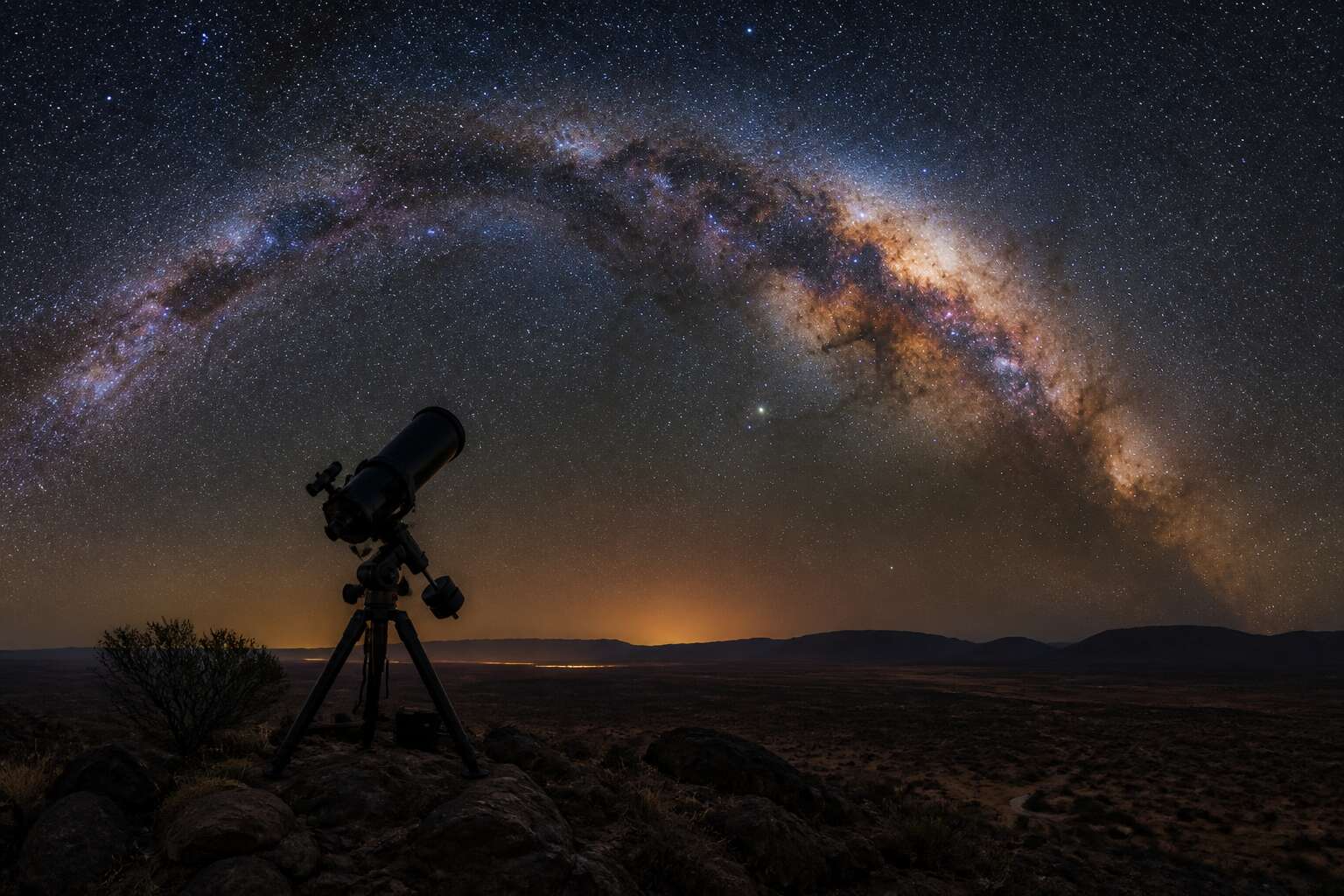
Understanding South Africa’s Stargazing Environment
Prime Observing Spots in Rural and Coastal Areas
South Africa is one of the few places where the Milky Way’s dusty core is visible without magnification. Sutherland, in the Karoo, hosts the Southern African Large Telescope, and the surrounding skies are legally protected from light pollution. That matters when you compare the best telescopes south africa.
Rural areas offer dry, stable air that suits crisp optics. Coastal towns like Paternoster give you maritime clarity, but also salt spray and persistent breeze. A telescope that thrives in one environment may struggle in the other.
Think about your own skies:
– Karoo nights reward serious magnification and precise collimation.
– Coastal evenings demand compact build and sealed lenses.
Choose your observing post before you choose the scope, since conditions will dictate the right tool entirely.
Southern Hemisphere Sky Highlights and Constellations
The southern hemisphere sky does not obey northern expectations. Crux, the Southern Cross, pivots around the celestial pole, while the Large Magellanic Cloud sprawls across the dark with no equivalent in northern charts. Anyone searching for the best telescopes south africa must first accept that their targets are different. Low magnification reveals the Magellanic Clouds as luminous patches, not points of light.
Atmospheric clarity varies with latitude and altitude, but the constellations remain dependable. Before committing to a scope, spend an evening learning these waymarks:
- Alpha and Beta Centauri, the Pointers that aim directly at Crux
- Omega Centauri, a globular cluster that appears as big as the full moon
- Eta Carinae, a nebula with a star that might explode any century
The right telescope, chosen after considering the local sky, will reward you with sights that never rise in the north.
Critical Telescope Features to Evaluate Before Purchase
Aperture Size and Light Gathering Ability
There is a common misconception that a telescope’s power lies in its magnification. In reality, the most critical specification is the aperture, which is the diameter of the main lens or mirror. In South Africa, where the Karoo skies offer some of the clearest views on the planet, a larger aperture is what separates a faint smudge from a breathtaking view of the Lagoon Nebula. This size dictates how much light your instrument can gather, which ultimately determines the faintest objects you can observe. A small 70mm scope is fine for a quick peek, but it will pale in comparison to a 200mm model when you are hunting down distant galaxies.
When you browse for the best telescopes south africa, pay close attention to this number. The light gathering ability increases with the square of the aperture, meaning a modest jump in size makes a significant difference in brightness and resolution. Consider what you will realistically be doing. For a beginner focusing on the Moon and planets, a 90mm refractor is adequate. For the serious hobbyist wanting to resolve globular clusters from an urban spot in Johannesburg, you will need to push towards 250mm or more.
Here are the primary functional results of increased aperture:
– Brighter images of deep space objects like nebulae and galaxies.
– Finer detail visible on planetary surfaces, such as the cloud bands of Jupiter.
– The ability to use higher magnification without the image becoming too dim.
Do not get seduced by a high focal ratio or marketing jargon. The aperture is the engine. Everything else, such as the mount stability and eyepiece quality, is just the steering wheel. A shaky mount on a superb optical tube will frustrate you more than a stable base with a smaller lens. So, check the specifications carefully. The ultimate benchmark for any telescope in the southern hemisphere is its ability to pull in the sparse, ancient light from our galactic centre. That is where the real value lies for anyone searching for the best telescopes south africa.
Mount Types: Alt-Azimuth vs Equatorial
Nearly 40% of new telescope owners in South Africa quit within a year, and most trace that to a wobbly mount. An alt-azimuth mount swings left, right, up, and down. It is simple, perfect for a quick lunar peek. But for deep space tracking, an equatorial mount aligns with Earth’s rotation and holds targets steady for hours.
- Alt-azimuth: lighter, cheaper, faster to set up.
- Equatorial: heavier, pricier, but essential for astrophotography.
When you search for best telescopes south africa, ask whether your focus is observing or photographing. Long exposure astrophotography demands an equatorial design, while visual work tolerates an alt-azimuth. A skilled observer can manage with either, but the mount must match your goals. The true test is pointing your scope at a star and watching it stay centered without constant manual adjustment. That test defines best telescopes south africa in every budget.
Optical Design: Refractor, Reflector, and Compound
When comparing best telescopes south africa, the optical design determines how light is collected and focused. A refractor uses a glass lens at the front, delivering sharp views of the Moon and planets. A reflector uses mirrors, which provide more aperture per rand, a real advantage for faint southern objects like the Tarantula Nebula.
Compound telescopes, including Schmidt-Cassegrains, combine lenses and mirrors to fold the light path. They balance portability and versatility in a compact tube. Yet every design has inherent trade-offs:
- Refractors: sharp, low maintenance, but heavier per aperture size.
- Reflectors: excellent value, though collimation is occasionally required.
- Compound: flexible and transportable, but they need time to reach ambient temperature.
Your choice depends on how you plan to observe and where you will set up. Many South African amateurs prefer a simple reflector for their first telescope, and that combination still ranks among the best telescopes south africa offers for visual stargazing.
Portability and Setup Time for Local Conditions
Ask any observer who has driven from Johannesburg to Sutherland and they will tell you the same thing: setup time is the real test of a telescope. A tube that needs 20 minutes of assembly will end up staying home. In my experience, the best telescopes south africa offers for travel are those that balance weight, length, and quick installation.
Consider the boot space of your own vehicle first. A Maksutov tube on a small alt-az mount can slide onto a passenger seat without trouble. A full Newtonian on a tripod demands the back row folded down, and that effort adds up over a season.
- Assemble the telescope indoors once, then time the teardown yourself.
- Check whether the tripod legs use locks or thumbscrews, since gloves limit dexterity.
- Confirm the tube fits across the back seat, not just in the boot.
South African nights reward an efficient setup. You will be observing while others still unpack their gear.
Budget Considerations and Long-Term Value
Few purchases punish a hasty decision like a telescope. A bargain reflector can feel like a betrayal when the focuser wobbles at a Karoo star party. The best telescopes south africa offer often reward patience rather than impulse.
Budget considerations should factor in the whole system. The optical tube alone is only the beginning. Consider:
- Eyepieces and a decent finder
- A collimation tool
- Dew shields for humid coastal nights
These items add up. I have seen observers spend more on accessories than the scope itself, and many regret it.
Long-term value comes from build quality and available support. Check whether local suppliers stock replacement parts. A scope with a solid mount and a warranted mirror will serve for decades.
Popular Telescope Categories for South African Stargazers
Compact Refractors for Urban and Balcony Use
Cape Town’s infamous south-easter might keep your telescope indoors, but the city’s persistent light dome demands a different approach. Compact refractors shine in this environment. Small aperture doesn’t mean small performance. A 70mm to 90mm refractor handles high power well, keeping the Moon and bright planets crisp. They cool down fast, so you can set up and observe within minutes.
For flat-dwellers, these scopes are a salvation. The short tube fits on a sturdy camera tripod. No heavy counterweights are needed, no lengthy polar alignment. You slide open the balcony door, mount the scope, and you are ready. It makes the difference between a hobby and a habit.
When comparing the best telescopes south africa has to offer for this category, a few models stand out:
- The Sky-Watcher Startravel 80, a light grab-and-go achromat perfect for low-power sweeping.
- A Celestron AstroMaster 70AZ, which offers a solid, stable alt-azimuth mount suited for tabletop or tripod use.
- The Bresser Messier 90mm, which provides a bit more light grasp for resolving lunar craters.
Each one eliminates the heavy-lifting fatigue that kills observing sessions. You are not chasing faint galaxies from a suburb. You are getting sharp, clean views of lunar craters, Saturn’s rings, and the phases of Venus. That is the value proposition. The best telescopes south africa for urban dwellers are the ones that get used, not the ones that collect dust in a corner. A compact refractor delivers that consistency. It is a tool for the real world, not just for a remote dark-sky site.
Large Dobsonian Reflectors for Deep-Sky Observing
The southern Milky Way over the Karoo presents a staggering spectacle. Large Dobsonian reflectors excel in this environment. Their simple mounts and large mirrors collect light from faint objects with ease. For a stargazer who owns a bakkie and reaches a dark site, these telescopes provide views that smaller optics simply cannot match.
Consider what these scopes handle best:
- Omega Centauri resolving into thousands of stars
- Eta Carinae’s glowing lobes and dusty keyhole
- Faint edge-on galaxies in Fornax and Sculptor
Among the best telescopes south africa has to offer, the large Dobsonian stands out for deep-sky work. Its simple design and big mirror justify every trip to the countryside.
Versatile Compound Telescopes for Astrophotography
A 200mm Schmidt-Cassegrain fits 2000mm of focal length into a 430mm tube. That makes these scopes the standard tool for planetary imaging and deep-sky photography from Cape Town suburbs to Highveld farms. Their closed tubes resist dust and dew, which matters in the Karoo’s dry nights and the coast’s damp air.
The best telescopes south africa offers for imaging often include compound designs. Their long native focal lengths suit high-resolution work on the Moon and planets. They offer:
- Moderate aperture in a portable package
- Native focal ratios around f/10 for lunar and planetary work
- Threaded rear cells for attaching cameras and filter wheels
A reducer corrector turns the same scope into an f/7 astrograph. One instrument covers both use cases, which saves money and storage space!
Where to Source Telescopes and Get Expert Advice in South Africa
Specialty Astronomy Retailers in Cape Town and Johannesburg
South Africa’s telescope retail scene is small but serious. Anyone hunting for the best telescopes south africa will find more value in a specialty shop than in a general electronics store. In Cape Town and Johannesburg, dedicated astronomy retailers offer practical knowledge from people who observe under local skies.
These dealers understand highveld haze and coastal humidity. They can explain why a particular eyepiece works better at Sutherland or how to maintain a mirror in damp weather. A good shop will let you handle the optics before paying. Expect services like these:
- Mount stability testing before purchase
- Guidance on cooling times for large reflectors
- Honest opinions on budget versus long-term investment
That advice is worth more than the price difference. The specialist’s counter, not a website, is where a sensible purchase truly begins.
Online Stores with Local Warranty and Support
Not every telescope buyer lives near a specialty shop. Online stores across South Africa have expanded the options for anyone searching for the best telescopes south africa. The challenge is identifying dealers who back their products with a genuine local warranty and a functioning support network, rather than a simple dispatch service.
Reliable online vendors display their after sales conditions openly. These indicators separate a real astronomy supplier from a general importer:
- Warranty claims handled by an authorised local technician
- Spare parts held in country for common failure points
- Access to an advisor during business hours without a ticket system
That accountability becomes critical when a mount arrives with a transit fault. A local warranty sends your claim to a desk in Johannesburg or Cape Town, not to a distant overseas warehouse. It also shortens the repair turnaround. Some dealers even loan replacement units while your equipment is being fixed. When you compare the price against the support, the right online store delivers the same security as a physical counter.
Second-Hand Marketplaces and Astronomy Clubs
Second hand marketplaces hold a quiet appeal for anyone tracking the best telescopes south africa. Platforms like Bidorbuy and Facebook Marketplace list used Dobsonians and refractors every week. A scratched tube often hides a mirror in excellent condition. Always inspect the optics with a torch and test the focuser before you commit.
Astronomy clubs offer a different kind of access. The Pretoria Centre and the Cape Centre host regular observing evenings where members display their instruments. Beginners can compare refractors, reflectors, and compound designs under actual southern skies. Clubs also receive donated telescopes from retiring members. New owners often pay nothing beyond a promise to attend and learn.
- Check for dust or fungus on lenses
- Verify all slow motion controls respond
- Confirm the mount supports the tube without wobble
Telescope Rentals and Test Before You Buy
Telescope rentals offer a low risk path toward finding the best telescopes south africa. Specialist shops in Cape Town and Johannesburg now loan out refractors and compound models for weekend stargazing. A modest fee covers delivery and a basic orientation session. First time buyers avoid the regret of owning an unsuitable scope.
Before you commit, set up the rental in your own backyard. Work through a simple checklist:
- Test the mount’s stability during slow movements.
- Focus on a bright star and measure the time to clarity.
- Move the scope between two targets to assess ergonomics.
This hands-on experience reveals more than any product specification ever will. Rentals also provide access to expert advice. Shop staff often share observing targets for the current season. Use their guidance to compare different designs without pressure. A short rental period is enough to decide whether a Dobsonian or a compact refractor suits your routine. This trial process turns speculation into certainty.
Reading Local Reviews and Community Feedback
Every month, I meet stargazers who bought blind, then sold at a loss. The best telescopes south africa rarely end up in stores first. They arrive through word of mouth, club bulletin boards, and community forums. A local reviewer who has owned the same model for a year offers more than any sales pitch.
Start with the Cape Town Astronomy Association or the Johannesburg Centre of the Astronomical Society of Southern Africa. Their members test gear under local skies. They know which collimation holds up in the Karoo, which tripod handles the Cape wind.
- Check the ‘For Sale’ threads on Cloudy Nights and the ASSA forum.
- Ask about a scope’s behavior during high humidity nights.
These voices shape the market. The right source is often a name on a forum, not a brand on a box.
Import Considerations and Customs Duties
Importing a scope directly from overseas can feel like a negotiation with bureaucracy. Customs duties and VAT add roughly 20% to 30% on top of the purchase price, and the courier may hold your parcel for weeks. The best telescopes south africa often arrive through local importers who have cleared the paperwork and handle warranty claims without shipping your unit back to another hemisphere.
Expert advice lives inside these channels. A dealer who imports a specific mount knows its quirks under Southern Hemisphere skies. An independent astronomer running a small import business can tell you which models survive coastal salt air. I have watched buyers skip the basic questions and pay double in the end. Ask for the full landed cost, including clearing fees and delivery.
- Who pays if the parcel arrives damaged?
- Does the warranty require overseas return?
- What is the realistic delivery window?
Hidden fees appear across local forums. Treat the import process as part of the telescope itself. When the total cost matches your budget and on the ground support exists, you own one of the best telescopes south africa can provide.
Essential Accessories and Upgrades for Optimal Viewing
Eyepiece Selection for Different Magnifications
Selecting the right eyepiece changes how your best telescopes south africa perform in practice. A 25mm Plössl gives you sweeping views of the Milky Way’s dense star fields, while a 9mm delivers sharp close-ups of lunar craters and planetary bands. You will likely settle on three or four focal lengths after a few nights of observing.
Consider a Barlow lens to double or triple magnifications without buying extra glass. A neutral density filter cuts lunar glare, and a light pollution filter helps if you view from urban areas like Pretoria. Eyepiece quality outweighs quantity. A cheap 4mm often produces blurry images, while a decent 10mm with generous eye relief offers comfortable viewing. Store eyepieces in a padded case to protect the coatings from humidity.
Filters to Enhance Planetary and Nebula Views
Filters often make the difference between a mediocre view and a revelation! A UHC filter isolates the emission lines of nebulae, transforming the Orion Nebula from a faint smudge into a structured cloud. For planets, a 80A blue filter sharpens the Great Red Spot and festoons on Jupiter’s belts. Consider these common options:
- UHC for emission nebulae
- OIII for supernova remnants
- 12 yellow for Mars
- 80A blue for Jupiter
These small investments extend the capability of any of the best telescopes south africa. Under the country’s dark rural skies, a simple filter often reveals details that otherwise remain invisible.
Red Dot Finders and GoTo Systems
Nothing humbles an astronomer faster than a red dot finder that has drifted, turning a GoTo mount into an instrument of random astrophysics. A quality finder with a clean reticle and brightness control is the first essential upgrade, especially when your favourite galaxy hides behind a power line.
For anyone comparing best telescopes south africa, a GoTo system becomes indispensable once you concede that manual star hopping ends in neck strain. Two star alignment on Achernar and Canopus, then the machine obeys. But update the firmware, or expect your scope to salute the southern horizon.
- A quick release saddle for painless setup
- A USB port for controller updates
- A reflex sight with true zero retention
Collimation Tools for Reflector Maintenance
In the previous section, we discussed Red Dot Finders and GoTo Systems, and how a faithful reticle saves your sanity. But the true equalizer for any reflector owner in this country is collimation. A laser collimator with a holographic grid transforms a tedious chore into a five minute ritual. You will know the moment it clicks, when the secondary mirror centres itself and the primary returns a single, sharp dot. Shopping for the best telescopes south africa often leads you to Newtonians, which arrive slightly out of alignment after shipping. A cheshire eyepiece and a collimation cap are the simplest tools, though a barlowed laser offers superb precision for the primary mirror.
A basic maintenance kit completes the ritual. Keep a soft brush, a blower, and isopropyl alcohol wipes in a sealed case. Dust on the secondary mirror creates a halo around bright planets, while dew on a compound scope ruins a night faster than any cloud. For Newtonian owners, upgrade the secondary holder screws to Bob’s Knobs for tool free adjustments. Check the primary mirror springs for drift during long observing sessions. The quiet satisfaction of a properly collimated scope is that it performs at its true aperture, and that is the real upgrade.
– A laser collimator with a crosshair reticle for quick checks
– A cheshire eyepiece for primary mirror alignment
– A nylon tool for adjusting primary springs
– A sealed cleaning kit with blower and wipes
You do not need a complex gadget for every task. Sometimes the best upgrade is simply learning to trust your tools. The best telescopes south africa will always rely on the observer’s discipline. A scope that is clean and aligned will outperform a neglected larger aperture. In a country with such rich southern skies, that performance is worth every rand spent on maintenance.
Power Solutions for Field Use
When you pack your rig for a remote Karoo site, the enemy is a flat battery. A GoTo mount can drain its internal cells by midnight. I always carry a 12V lithium jump starter, one that outputs 8 amps, to run the mount for two consecutive nights. For solar observers, a foldout panel works, but only if you remember to charge it before sunset.
- 12V sealed lead-acid battery with SAE leads
- USB power bank for dew heaters and cameras
- Inverter for laptops and star trackers
The lightest setup is a pair of 18650 cells in a holder, taped to the tripod leg. Check the polar alignment first! Because a dead battery after setup is a lesson. The best telescopes south africa will test your patience, but a spare power source turns frustration into a successful night.
Getting Started and Maintaining Your Telescope in South Africa
Beginner Setup Checklist for First Light
Your first session with a new telescope in South Africa should start indoors. Allow the instrument to acclimatise for at least thirty minutes. A warm tube in a cold Karoo night produces convection currents that smear Jupiter into a shimmering blob. Use the time to review your setup routine.
Here is a practical sequence I follow:
- Set up the tripod on grass or compacted soil, never concrete.
- Attach the optical tube and hand-tighten the knob.
- Insert a low power eyepiece, around 25mm.
- Adjust the mount tension so the tube moves smoothly without drifting.
- Balance the assembly using the counterweights or saddle clamp.
After dark, start with the Moon or a bright star like Canopus. Keep both eyes open and relax. For maintenance, clean the optics only when dust visibly reduces contrast. Use a blower brush, never canned air. This simple ritual ensures your investment, one of the best telescopes south africa offers, provides years of clear southern views.
Aligning Your Finder Scope and Mount
Starlight does not forgive a misaligned finder scope. Before you chase the Jewel Box or the Magellanic Clouds, your finder must agree with your main tube. One frustrating night taught me this: a red dot that promised one star delivered another, and I spent an hour hunting the wrong patch of sky.
Aligning the finder is straightforward:
– Centre a distant target in the eyepiece, a rooftop antenna or a church spire.
– Adjust the finder screws until the dot rests on the same point.
– Repeat with a second target to confirm accuracy.
The mount deserves equal attention. On an equatorial mount, check polar alignment; on an alt-azimuth, lock down the clutches. Tension that feels wrong in daylight will feel worse at 2am. A well aligned setup turns the best telescopes south africa has to offer into instruments of certainty. Maintain that honesty: tighten the screws, wipe the finder lens, and trust what you see.
Regular Cleaning and Storage Tips to Combat Humidity
Owning one of the best telescopes south africa means dealing with dew. I spent a damp morning in Durban wiping moisture off a corrector plate before I understood the threat.
Clean optics sparingly. Use a blower for loose dust, never a dry cloth. For stubborn residue, a microfiber cloth with a drop of isopropyl alcohol works well. Salt air near the coast accelerates corrosion, so wipe the tube and eyepieces after every session.
Follow a simple storage routine:
- Let the telescope warm to room temperature before capping.
- Remove the eyepieces and store them separately.
- Add silica gel sachets to the case.
- Keep everything off the floor, away from exterior walls.
Humidity is relentless! Fungus etches coatings in months. The best telescopes south africa survive for decades when owners treat cleaning as ritual, not chore.
Joining Local Astronomy Societies and Observing Events
The best telescopes south africa demand more than a single night of wonder. They ask for routine, for patience. I learned this after a damp evening in the Magaliesberg, when a misaligned finder turned a promising session into forty minutes of frustration. Maintenance is a quiet ritual. Check the mount, inspect the optics, tighten the bolts. A telescope that is cared for becomes an instrument of reliability.
Local astronomy societies carry this knowledge forward. Groups in Pretoria, Durban, and Cape Town hold regular observing events where newcomers and veterans share the same eyepiece. This is where the practical details surface, the ones no manual explains.
- Access to dark sky sites without long travel
- Hands on help with collimation and alignment
- Advice on the best telescopes south africa for your specific climate
Attend one event, and the solitary hobby transforms into a shared pursuit. The sky becomes familiar, and the equipment follows suit.
0 Comments