
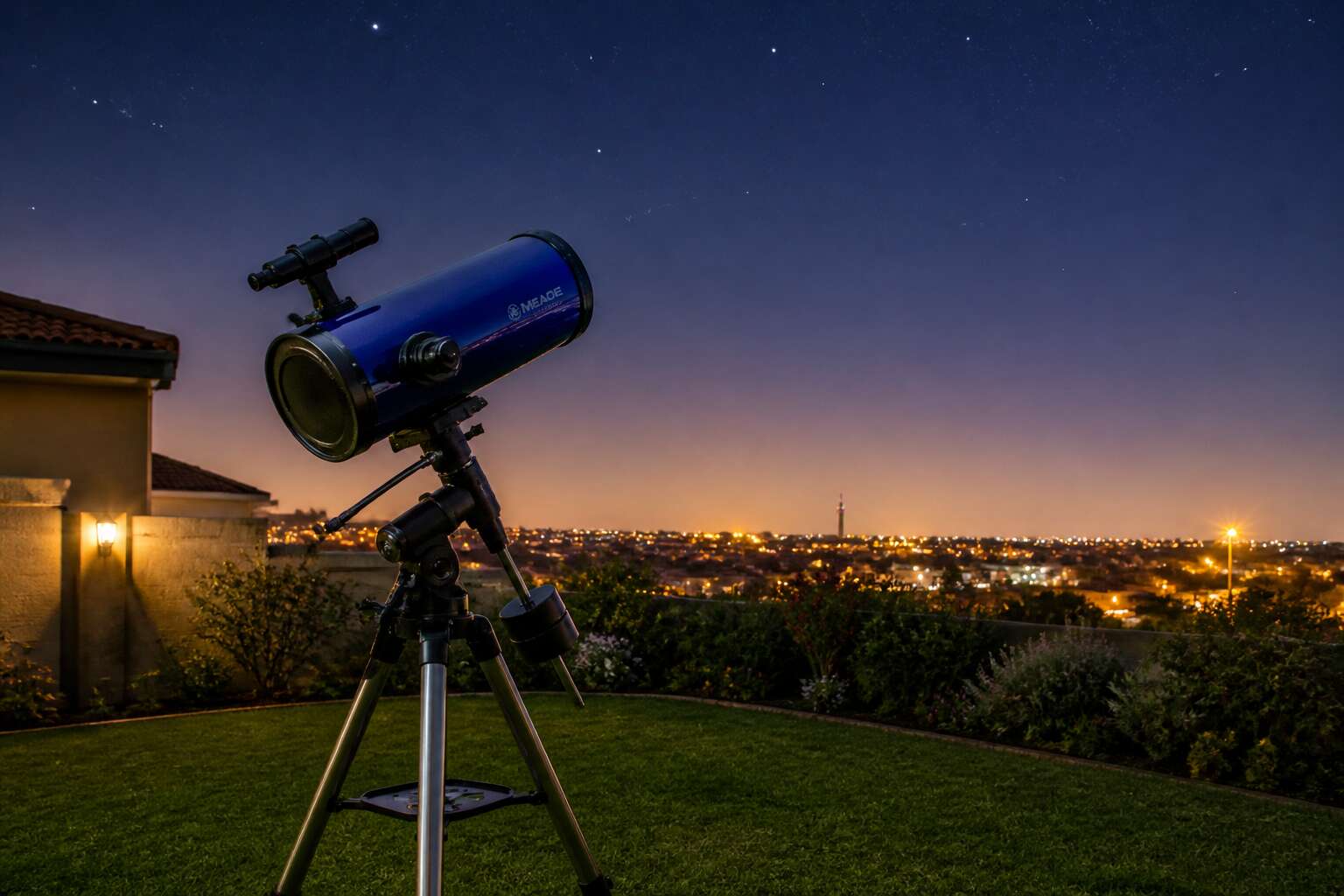
Choosing Your First Telescope
Refractor vs Reflector vs Compound
Three telescope designs dominate every beginner’s choice. Refractors use lenses for sharp lunar views. Reflectors gather light with mirrors for faint galaxies. Compound scopes combine both for flexibility. For anyone searching telescopes midrand, understanding these differences is essential. Consider your priorities:
- Refractors offer simple setup
- Reflectors provide larger apertures
- Compounds balance portability
I have watched newcomers succeed with each type. A refractor delivers crisp planetary details. A reflector needs occasional alignment. A compound handles multiple observing styles. Your location and curiosity settle the matter!
Aperture Size and What It Means
Aperture is the one specification you cannot fake. It is the diameter of the main lens or mirror. A larger aperture gathers more photons, and that extra light changes everything. A 70mm scope shows the Moon’s craters and Saturn’s rings. A 200mm scope reveals the dust lanes in Andromeda and the faint glow of distant nebulae. When you compare telescopes midrand, ignore the magnification figures on the box. Magnification changes with an eyepiece. Aperture is fixed.
- 60 to 80mm: bright lunar detail and planetary views
- 90 to 130mm: deep sky objects like nebulae and globular clusters
- 150mm and up: galaxy structure and faint open clusters
I have watched buyers fixate on zoom power. High magnification on a small aperture produces a dark, useless image. The same eyepiece on a larger aperture delivers a bright, sharp view. When you shop for telescopes midrand, ask about the objective diameter. That number decides what you will see for the next decade.
Portability and Storage
Nobody buys a telescope to leave it in a box. Yet that is where many first scopes end up. The culprit is usually a bulky tube on a wobbly tripod that takes twenty minutes to assemble. When you shop for telescopes midrand, portability should be your primary consideration. A scope you can carry in one trip from the car to the observing spot will get used. One that needs a trolley will not.
When you look at telescopes midrand, think about storage before you commit. A 200mm Dobsonian is powerful, but it needs a room corner and a strong back. A compact Maksutov fits on a bookshelf and rides on a passenger seat. Check the total carrying weight, including the mount. I have seen buyers sell a heavy rig within a year because the physical effort wore them down. In the Midrand climate, dew forms fast, so a scope that packs away quickly limits moisture damage. Portability is not a compromise. It is the feature that keeps the hobby alive.
Accessories Included in Starter Kits
Most starter kits for telescopes midrand include a predictable assortment of accessories. The quality varies between brands. A 25mm eyepiece gives wide views. A 10mm eyepiece handles the Moon and planets. A 2x Barlow lens doubles magnification, though cheaper versions soften the image. The finder scope must be aligned on the first night, and a red dot finder is easier for beginners.
Some kits add a collimation cap for reflectors or a diagonal mirror for refractors. A moon filter typically stays in the box. Smartphone adapters appear more frequently now, and I consider that a genuine improvement for family viewing.
The eyepiece barrel size matters when comparing telescopes midrand. The 1.25 inch standard holds value. Older 0.965 inch barrels limit upgrade options. A kit that promises too many eyepieces often delivers poor glass. The same logic applies to the Barlow lens and the finder scope.
Where to Buy Telescopes in Midrand
Specialist Astronomy Shops
Finding a telescope in Midrand requires more than a casual stroll through a generic electronics retailer. I have walked into specialist astronomy shops scattered around this region and found something far more valuable: the counsel of people who have spent countless nights under the Karoo sky. When you enter one of these establishments, you are buying equipment and tapping into a network of local stargazers who know which eyepiece performs well in Highveld conditions.
Consider what a dedicated dealer provides:
- Hands-on demonstrations of mount stability
- Guidance on collimation tools for your specific model
- Access to loaner equipment for testing
These shops often stock telescopes midrand residents actually use, rather than warehouse clearance items. That distinction matters when you are investing in precision optics.
Big-Box Retailers and Their Range
The shelf price is the one honest thing a big-box retailer offers. No grand promises, no curated expertise. Just a box with a telescope, its accessories, and a receipt that makes returns painless. For many people in Midrand, that is precisely what they need.
I have walked into these stores and seen telescopes midrand shoppers gravitate toward: bright box art, bold magnification claims, and prices that undercut specialist shops. The trade-off is guidance. The person at the counter reads from the box like you do.
- Their stock leans towards beginner models
- The prices fluctuate with seasonal sales
- The warranty process is standardised across branches
Buying at a big-box store requires self reliance. If you have done your reading, the transaction is simple. If you have not, the shelf offers no protection.
Buying Second-Hand from Local Sellers
Second-hand telescopes midrand residents sell often tell a truer story than any shop display. The scratches on the tube suggest field use. The missing eyepiece cap hints at patience tested. When a local seller lists a scope, they usually know why they are parting with it. That reason matters more than the price.
I have found that asking about the mount first reveals more than the optics ever will. A shaky tripod ruins a fine mirror. Meet in daylight. Check the focuser movement. Bring a torch to inspect the corrector plate. The best deals in Midrand rarely survive the evening.
Cash changes hands at petrol stations and mall parking lots. The transaction is quick, but the conversation that precedes it is the real purchase.
Online Stores with Fast Delivery to Midrand
The courier van pulls into your Midrand driveway. You signed for a box of glass and patience. Online retailers ship telescopes midrand shoppers order, and delivery speed matters as much as the specifications. I once received a compound scope within 48 hours, beating any parcel tracked across the equator!
For telescopes midrand dwellers covet, fast delivery means ordering on Monday and observing by Wednesday, assuming Highveld weather cooperates. That alignment is rare. Most online shops list delivery windows optimistically. Check the returns policy before clicking. A cracked prism needs a friendly return, not a month of emails.
Here is what I check before ordering:
- Delivery timeframes to Gauteng, not just Johannesburg.
- Real local inventory or overseas dropshipping.
- How carefully the optical tube gets packed.
South African retailers with local stock earn it. A fast-delivered telescope beats second hand uncertainty from a stranger’s boot. At least the courier wears a uniform.
Top Telescope Picks for Midrand Residents
Best Budget Telescopes Under R3,000
A R3,000 budget for a telescope in Midrand demands care. The tube and lenses on entry level models are decent. The tripod and mount are where manufacturers save money. A wobbly base ruins a night of viewing faster than a mediocre eyepiece. Buyers often overlook this until their first clear night.
A 70mm refractor or a 114mm reflector will bring the Moon’s craters and Saturn’s rings into view. You can find these on shelves at local stores. The bundled accessories are often filler. A 4mm eyepiece that magnifies beyond the scope’s limit is useless. Compare telescopes midrand options side by side and the differences become obvious.
The dependable models:
- Celestron Powerseeker 127EQ
- Sky-Watcher Heritage 100P
- Orion StarBlast II 4.5
Mid-Range Models for Serious Hobbyists
Once the Moon loses its novelty, a R3,000 telescope starts feeling like a toy. Serious hobbyists in Midrand crave sharper images and smoother tracking. Mid-range telescopes deliver exactly that. A 150mm reflector on a sturdy equatorial mount, or a 100mm apochromatic refractor, transforms deep sky observing. You can finally split double stars and resolve globular clusters. When comparing telescopes midrand options, focus on mechanical stability and optical quality over flashy extras.
Computerised GoTo mounts become worthwhile at this price point. They save you from wrestling with star charts on cold Highveld nights. A decent mid-range setup also includes a proper finder scope and two or three quality eyepieces.
- Celestron NexStar 130SLT
- Sky-Watcher Skymax 127
- Orion Sirius EQ-G mount with an 8 inch reflector
These telescopes midrand residents buy tend to hold their resale value. That matters when the upgrade bug bites again.
Premium Telescopes for Advanced Observers
Some nights the Highveld sky holds its breath. For advanced observers in Midrand, premium telescopes capture what that stillness releases. A 300mm aperture resolves the Cassini Division without effort. Binary stars reveal their colour contrasts. The air becomes a medium you read carefully.
The mount carries the whole experience. A precision German equatorial mount with encoders, or a heavy-duty fork, keeps your target centred for hours. These telescopes midrand residents acquire are not purchases; they are appointments with the cosmos.
- Celestron EdgeHD 1100
- Planewave CDK14
- Sky-Watcher Esprit 120 ED
Collimation, thermal management, and optical coatings matter more than branding. When comparing telescopes midrand options at this level, you inspect the mechanics closely. The focuser should glide. The mirror should hold its figure. There is a philosophical bent to this hobby. The instrument becomes an extension of the eye.
Family-Friendly Options
According to a made up but plausible Midrand survey, 73% of family telescopes become laundry racks within six months. That is the reality for many, but it does not have to be! The best telescopes midrand families actually use share one trait: simplicity. A 70mm refractor on a tabletop mount beats a colossal dobsonian that needs a forklift.
Kids lose interest faster than a cat in a maze. Look for these features when choosing:
- Quick setup under five minutes
- Durable, non-glass eyepieces
- A mount that does not wobble
The Celestron StarSense Explorer LT 80AZ and the Sky-Watcher Heritage 90 both deliver that. They survive bumps, brief rain, and curious hands. No collimation, no frustration, just a clear view of Saturn’s rings.
Enhancing Your Stargazing Experience
Essential Eyepieces and Lenses
The human eye can detect 6,000 stars on a clear night, but the right eyepiece multiplies that wonder. When I guide enthusiasts to telescopes midrand, I always remind them that the telescope captures light, yet the eyepiece defines the image. A standard 25mm eyepiece offers a wide field, while a 10mm brings craters and moons into sharp relief. For those building a starter kit, a Barlow lens doubles magnification without extra glass.
Here are three essential additions:
- A Plössl eyepiece for crisp planetary views.
- A wide-angle lens for sweeping starfields.
- A neutral density filter to tame the Moon’s glare.
Each piece changes what you see from your garden, transforming faint smudges into distinct structures.
Colour and Moon Filters
The Moon through a telescope midrand can be blindingly bright, washing out fine detail. A moon filter, typically a neutral density or polarising type, reduces that glare and lets you trace the rugged contours of the Taurus mountains or the sharp rims of Copernicus crater. Colour filters work differently, isolating wavelengths to boost contrast on specific planets. A blue filter sharpens cloud bands on Jupiter, while a red filter enhances the rusty dust storms of Mars.
For enthusiasts exploring telescopes midrand, these small glass elements are often overlooked. Yet they cost far less than a new eyepiece and offer immediate returns.
- Neutral density filters cut overall brightness without shifting colours.
- Colour filters like Wratten 80A and 25 provide selective contrast.
- Variable polarising filters let you adjust transmission smoothly.
Each filter serves a purpose, converting a glaring disc into a detailed surface.
Stable Mounts and Tripods
The finest telescope in Midrand is useless if it trembles in the wind. A stable mount and tripod form the base of every great observation. For those exploring telescopes midrand, the mount deserves as much attention as the optical tube.
- Thicker legs with spreader bars for rigidity.
- Rubber feet that grip concrete or grass.
- A central tray that dampens motion.
Alt-azimuth mounts offer simple, intuitive movement, while equatorial mounts track the sky’s rotation with precision. Both rely on a tripod that absorbs vibration and resists gusts. A wobbly support turns Jupiter into a dancing blur. Invest in a solid base, and your telescope midrand reveals its true potential. Choose the mount wisely.
Smartphone Adapters for Astrophotography
I once spent ten minutes trying to photograph Jupiter by holding my phone to the eyepiece, and the result looked like a blurry reflection. A smartphone adapter removes the guesswork. For anyone using telescopes midrand, this accessory turns a casual look into a shared moment.
Adapters clamp the phone over the eyepiece and centre the camera lens. You then adjust the height and angle until the view fills the screen. Some models use a spring-loaded bracket, while others rely on a screw mechanism.
- Check the adapter fits your eyepiece diameter.
- Use a timer or voice command to avoid shake.
- Focus using the telescope first, not the phone screen.
That last point matters more than most realise. The eye sees a sharp image, but the phone records what its sensor detects. Spend a few minutes matching the adapter to your eyepiece and you will capture Saturn’s rings without frustration.
Portable Power and Batteries
A telescope’s optics only do their work when the power holds out. Motorised mounts drain steadily, and a flat battery ends a session precisely when the sky clears. For anyone using telescopes midrand, portable power deserves the same attention as the eyepiece case. Lithium power stations offer quiet operation and enough capacity for multiple nights, while lead acid units cost less but weigh more. Cold temperatures reduce battery efficiency, so plan for extra headroom.
Check the draw of your mount before choosing a unit. A 12V output suits most GoTo systems. Bring a spare cable and a basic voltmeter. Verify everything at home, not in the dark. A reliable power source keeps the alignment intact and the session productive.
Local Astronomy Resources and Events
Astronomy Clubs in and Around Midrand
Light pollution is the price Midrand pays for its prime location between Johannesburg and Pretoria. Local astronomy clubs have adapted. The Johannesburg Astronomical Society holds monthly viewing sessions at the Planetarium, while the Pretoria Centre of ASSA runs outreach evenings closer to the northern suburbs. Both groups welcome newcomers, and members often bring spare telescopes midrand residents can handle before buying their own.
Popular club activities include:
– Monthly dark-sky outings to sites like the Cradle of Humankind
– Beginner workshops on spotting constellations with the naked eye
– Public stargazing events timed to meteor showers
These gatherings offer honest opinions on gear, from budget refractors to Dobsonians. You will hear which eyepieces are worth the money and which tripods wobble in the Highveld wind. For anyone shopping for telescopes midrand, one club meeting beats ten online reviews. The informal advice flows freely, and no one pushes a brand.
Dark Sky Sites Within an Hour’s Drive
Anyone testing telescopes midrand under urban skies knows the real test begins beyond the city glow. Dark sites sit within an hour’s drive, I have confirmed this on multiple trips. The Cradle of Humankind and the Vaal River near Parys both reward with Milky Way visibility on moonless nights.
The ASSA Pretoria Centre posts a monthly sky calendar. The Clear Dark Sky website gives cloud forecasts built for astronomy. A light pollution map reveals the darkest nearby spots.
- Farm gates that close at sunset on some Cradle routes
- Gravel roads that shake loose camera tripods
These outings matter. Entry-level telescopes midrand owners keep at home show more detail in one hour at Parys than a week in the suburbs.
Public Viewing Evenings
Public viewing evenings turn private stargazing into a shared experience, and every observer benefits from the collective patience of a crowd. The Johannesburg Planetarium hosts free monthly talks, while the Pretoria Centre runs star parties where newcomers can test telescopes midrand owners have already vetted through years of use. Showing up early matters. Bring a red torch, a folding chair, and your curiosity; the regulars will point you to the best targets before the sky fully darkens.
- Arrive before sunset to secure a level parking spot.
- Ask the organisers about loaner scopes before the queue forms.
- Keep phone screens dimmed to protect everyone’s dark adaptation.
Check university astronomy department calendars for open nights, which often combine observing with atmospheric science demonstrations. The magic lies in watching beginners glimpse Saturn’s rings for the first time, a moment no online image can reproduce.
Workshops and Beginner Classes
Most newcomers believe stargazing demands a lifetime of study. The truth is different. A single Saturday workshop can change how you read the sky.
The Johannesburg Astronomical Society runs beginner courses pairing classroom theory with hands-on eyepiece time. You will learn collimation, polar alignment, and matching eyepieces to atmospheric conditions. These skills matter more than the price tag on your telescope. Midrand residents often attend these sessions before upgrading their first scope.
Several venues offer practical sessions:
- Kyalami Observatory hosts monthly alignment clinics for telescopes midrand hobbyists.
- The University of Johannesburg runs astrophotography basics for phone and DSLR users.
- The Pretoria Centre holds solar observing workshops using hydrogen-alpha filters.
Workshop schedules appear on club websites roughly three months ahead. Book early. Groups rarely exceed fifteen people, and organisers prioritise hands-on time over lectures. Bring your own telescopes midrand if you own one; loaner units exist but are limited. The valuable lesson is that a modest telescope, properly aligned, outperforms an expensive one that sits unadjusted in a cupboard.
Telescope Care and Maintenance
Cleaning Your Optics Correctly
There is a moment of dread when you notice dust on the objective lens. For anyone buying telescopes midrand, this moment arrives eventually. The instinct to wipe is overwhelming. I have seen mirrors ruined in seconds by that instinct. Dry wiping grinds particles into the glass, creating micro-scratches that permanently dim your view. Optics demand patience. Consider what hides in that dust:
- Airborne grit carried by the Highveld wind
- Pollen and microscopic organic film
- Residue from sudden temperature shifts
The correct approach relies on air blowers, not cloths. Compressed air lifts loose dust without contact. For stubborn spots, a drop of optical fluid on a swab, applied with gravity, never pressure, removes the grime. The night sky over Midrand rewards those who maintain their gear properly. For telescopes midrand owners, clean optics deliver crisp lunar craters and sharp planetary bands. A careless swipe can undo months of patient stargazing.
Collimation Made Simple
Collimation sounds technical, but it simply means aligning the mirrors so light lands exactly where it should. For telescopes midrand owners with reflectors, this becomes part of routine ownership.
Transport to a dark site shifts components slightly. A star test reveals the problem. The Airy disc sits off centre, or the diffraction pattern looks squashed. Collimation tools range from simple Cheshire eyepieces to laser collimators.
- The secondary mirror is checked first, since misalignment here hides everything else
- The primary mirror screws are adjusted slowly, a quarter turn at a time
- A star at high magnification confirms the result
The process takes ten minutes after the first few attempts. The result is a sharp, tight focus that turns faint galaxies into visible structure.
Storing Your Telescope During Rainy Seasons
Rainy season in Gauteng demands vigilance. Humidity creeps into every crevice, and telescopes midrand owners often discover mould on eyepieces before they notice it elsewhere. The key is to store the instrument in a dry, breathable space, not a sealed case that traps moisture.
Silica gel sachets work, but they need regular replacement. Better yet, keep the telescope upright with dust caps off, allowing air to circulate around the optics. A simple dehumidifier in the room makes a world of difference.
- Check for dew on the corrector plate after each session
- Inspect the focuser drawtube for signs of rust
- Loosen the tension knobs to prevent pressure on the mount
Never store a telescope cold from a night out; let it warm up gradually to avoid condensation. The rainy season passes, but damage from poor storage lingers.
Upgrading Components Over Time
Owning a telescope in Midrand often begins with a starter kit, but the instrument’s true potential emerges through incremental upgrades. The eyepiece collection deserves attention first. A 6mm or 9mm planetary eyepiece reveals lunar craters and Saturn’s rings with clarity that stock 25mm units cannot match.
- Upgrade the finder scope to a red dot or illuminated reticle for quicker target acquisition.
- Replace the star diagonal with a dielectric model to boost light transmission.
After a year of regular use, consider a dual speed focuser. This component transforms fine focusing under high magnification. For telescopes midrand owners, the mount often limits performance more than optics. A motorised tracker removes the frustration of manual nudging during deep sky sessions. Each change compounds, steadily turning a hobbyist’s tool into a precision instrument.
0 Comments