
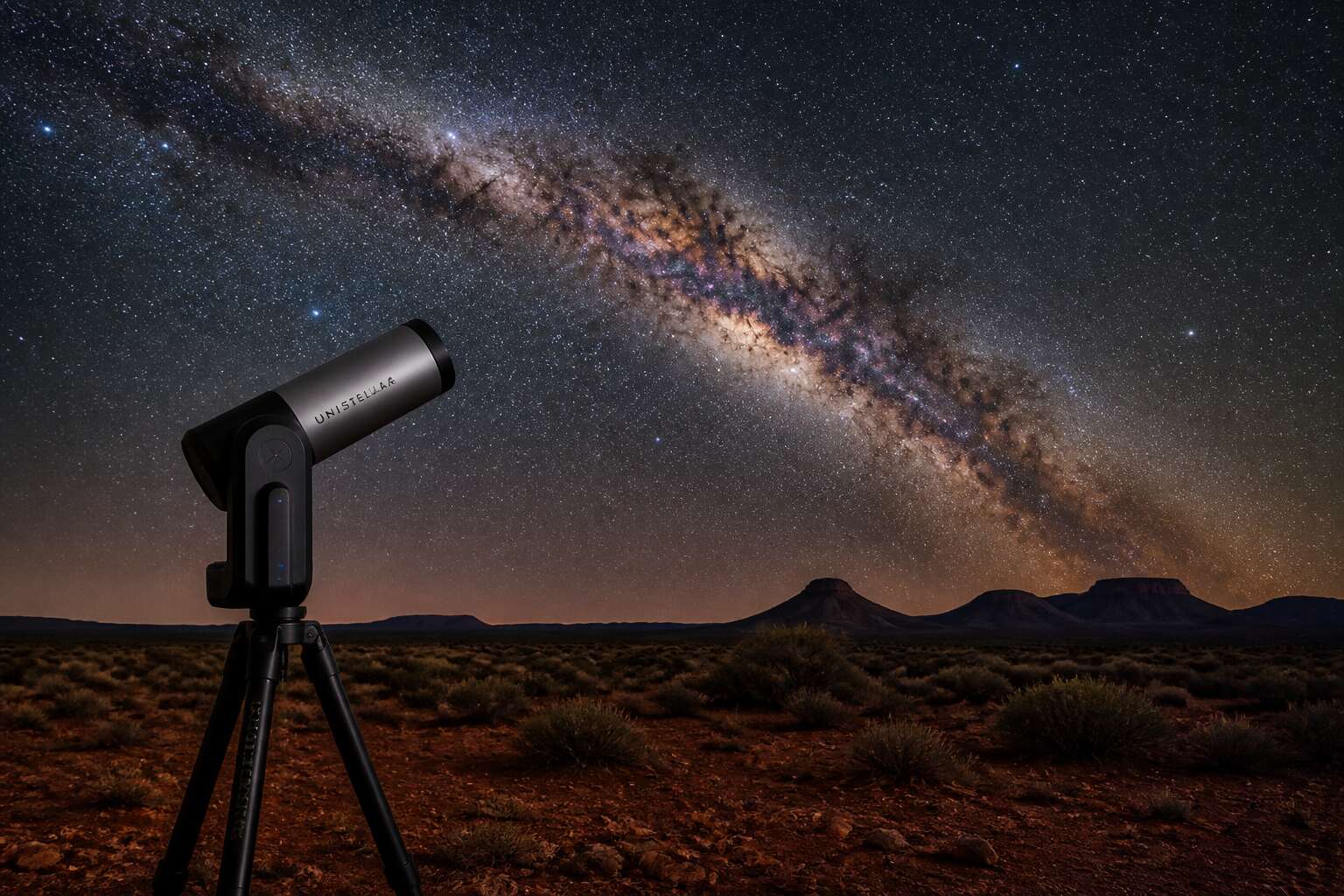
Why Unistellar Smart Telescopes Are Gaining Popularity in South Africa
The Rise of Smart Telescope Technology for Amateur Astronomers
South Africa’s night sky, particularly over the Karoo, remains one of the planet’s finest natural observatories. Yet most residents in Johannesburg or Cape Town rarely see the Milky Way through urban glow. Unistellar telescope south africa adoption is growing because these devices overcome that limitation.
The technology pairs a digital sensor with an onboard computer. Amateur astronomers select a target on a phone app and the telescope handles the rest. No more polar alignment spreadsheets or dodgy autoguiding rigs. I can confirm this removes most of the early frustration!
The appeal breaks down simply:
- Portable units fit in a carry-on bag
- Light pollution filters reveal nebulae from suburban patios
- Live stacking shows results on screen within minutes
That combination is turning casual stargazers into regular observers. Unistellar telescope south africa owners form a small but vocal community, swapping images of the Southern Pinwheel and Carina Nebula.
Key Features That Appeal to South African Stargazers
Once the first sharp image appears on a phone screen, there is no turning back. Unistellar telescope south africa owners quickly learn that the eVscope understands local observing conditions. I have watched it hold steady for hours while the afternoon’s berg wind settled. That stability matters! The onboard software compensates for atmospheric turbulence and humidity, essential factors on the Highveld.
The 7nm filter isolates hydrogen-alpha emissions, so the Carina Nebula emerges in crimson detail even from a Johannesburg garden.
Why is adoption spreading so fast?
- A lithium battery runs for up to 14 hours, outlasting the longest Karoo observing sessions
- The optical tube stays collimated by design, so bumpy gravel roads do not knock it out of alignment
- The app holds a catalogue of more than 4,000 southern deep-sky objects, selected for visibility from latitude 25 degrees south
Unistellar telescope south africa integration solves the practical problems that once made astronomy a weekend frustration.
How Unistellar Compares to Traditional Telescopes in Local Conditions
The Karoo night sky is unforgiving. A traditional telescope setup, with its counterweights and drift alignment, consumes the best observing hours before you ever find a target. In South Africa, where the Highveld weather changes in minutes, this is a fatal flaw. The unistellar telescope south africa sidesteps the entire ritual. You place it on a picnic table, let it calculate its position, and within seconds it holds a galaxy steady on your phone screen.
I have watched seasoned amateurs sell their eleven-inch SCTs after one night with this system. Why? Because it works within the brevity of a clear winter night. No collimation drills, no polar alignment headaches. The onboarding process is simply:
- Set it on any firm surface.
- Connect your device.
- Select an object from the catalogue.
Understanding the Appeal for Both Beginners and Experts
Six hundred new owners joined the local user group in the last twelve months alone. That growth is not coming from seasoned observers alone.
Beginners adopt the smart system because the entry ritual has dissolved. They spend their first night capturing galaxies, not wrestling a mount. Experts embrace it because the device respects their limited hours. A safari guide near Hoedspruit runs variable star timings between game drives, an impossibility with a twelve inch dobsonian. The unistellar telescope south africa network now spans every province, from Cape Town to the Lowveld.
Choosing the Right Unistellar Model for South African Skies
Overview of Available Unistellar Models and Their Specifications
Selecting a unistellar telescope south africa begins with how you intend to observe. The eVscope 2 packs a 4.5 inch aperture with a 450mm focal length and a fixed eyepiece, giving you the reassurance of direct viewing while its 32 megapixel sensor stacks hundreds of exposures to conquer urban light domes. The Odyssey Pro trades that simplicity for a 4.8 inch aperture, a redesigned equatorial mount, and interchangeable eyepieces, serving the observer who still wants hands-on control.
Key specifications to weigh:
- eVscope 2: 4.5 inch aperture, 450mm focal length, fixed eyepiece, 11W draw
- eQuinox 2: identical optics, no eyepiece, lighter travel chassis
- Odyssey Pro: 4.8 inch aperture, equatorial mount, swappable eyepieces
Battery endurance is another differentiator. The eVscope 2 pulls roughly 11 watts, while the Odyssey line stretches a single charge towards five hours of continuous autofocus, a decisive factor for remote Karoo sites. Let the terrain, not the marketing, choose your unistellar telescope south africa.
Portability and Setup Considerations for Travel and Remote Viewing
Driving to Sutherland, the last thing you want is a telescope that needs an hour of assembly. The Karoo rewards speed. For a unistellar telescope south africa, portability decides how many nights you actually capture.
The eQuinox 2 wins on pure travel. It has no eyepiece, no alignment dance. One bag, two minutes, done. The Odyssey Pro is different. It brings an equatorial mount and bigger aperture, but it asks for a patient setup. That trade makes sense for a weekend at a dark site lodge, not for a quick stop on the N1.
A simple packing check keeps things honest:
- Weight under 5 kg for carry-on ease.
- Battery life beyond four hours for remote Karoo sessions.
- Quick-release dovetail for field trips.
These small decisions separate a usable unistellar telescope south africa from a useless purchase.
Battery Life and Power Options for Off-Grid Stargazing Locations
Choosing the right Unistellar model for South African skies hinges on your relationship with darkness. Sutherland and the Karoo offer pristine skies, but they offer no power points. Battery life decides between a full night of capture and an early retreat.
I learned this on my first trip north of Cape Town. The eVscope 2 and eQuinox 2 deliver four hours of observation. The Odyssey Pro, with its larger aperture, drains faster. For off-grid stargazing locations, that distinction matters. Pack a portable power station or a solar panel to replenish the unit by midday.
Keep a simple checklist:
- Charge fully before departure, as remote sites rarely offer electricity.
- Bring a USB-C power bank above 20,000 mAh for extended sessions.
Cold Karoo nights deplete lithium cells faster. Keep the battery warm inside a jacket pocket until observation begins. A unistellar telescope south africa rewards you if the battery survives until dawn.
Connectivity: Smartphone and Tablet Compatibility in the Local Context
Few travellers consider how a stellar database behaves when the nearest tower is 80 km away. The Karoo’s night sky is flawless, but the mobile signal is not. The Unistellar app pairs with your smartphone over Wi-Fi, creating a private network between device and telescope. No external data connection is required for basic operation, which suits a unistellar telescope south africa owner seeking true darkness.
Firmware updates and object databases need a connection at some point. Download those while still in Cape Town. The app runs on recent Android and iOS devices, but older tablets may struggle with live view. Test your equipment before departing for Sutherland.
- Keep location services on, since the telescope uses your phone’s GPS for alignment.
- Switch to airplane mode after the Wi-Fi link is established, avoiding roaming interruptions.
- The Odyssey Pro’s high resolution stream demands a strong link, so keep the phone nearby.
A unistellar telescope south africa transforms when the phone pairs instantly, without the local heat causing thermal shutdowns.
Accessories and Add-Ons Recommended for Southern Hemisphere Observing
Southern skies demand a specific choice. The Large Magellanic Cloud stretches over seven lunar diameters, a target too wide for narrow fields. The Odyssey Pro captures it fully, while the eVscope 2 excels on compact wonders like the Jewel Box cluster.
For accessories, a red light headlamp preserves dark adaptation during long sessions. An extra power bank extends your night in the Karoo. A simple list helps:
- A UHC filter for emission nebulae like the Carina complex
- A wind-resistant base for Sutherland’s exposed observing sites
- Lens cleaning cloths for the fine desert dust
Darkness rewards preparation, and a unistellar telescope south africa performs best with these additions.
Best Practices for Observing the Southern Hemisphere with Unistellar
Understanding the Unique Celestial Objects Visible from South Africa
Some nights, the southern hemisphere serves up celestial objects that most northern observers never see. From Cape Town or Pretoria, the following deserve a second look with a unistellar telescope south africa:
- The Large Magellanic Cloud, a satellite galaxy with visible star formation.
- Omega Centauri, a globular cluster containing millions of stars.
- The Carina Nebula, a stellar nursery that changes appearance nightly.
Let the telescope’s algorithm lock onto the coordinates first. Give the field detection time to settle, then let the app guide you. Dark skies from a farm near Sutherland improve the view considerably. The telescope handles the processing; you simply observe.
Tips for Aligning Your Unistellar Telescope Using Visible Landmarks
Aligning a unistellar telescope south africa begins before sunset. Choose a position where you can see a distinct landmark, like a church steeple or a cell tower, against the horizon. Open the app and select manual alignment. Point the scope so the landmark sits dead centre in the field of view.
- Use the app’s crosshair, not your eye, for accuracy.
- Confirm the landmark on the map by tapping the exact spot.
- Wait for the confirmation chime before moving on.
The southern hemisphere rewards this preparation. Once aligned, let the mount track a bright star for several minutes before deep sky work. The optics stay locked on target, and you avoid the frustration of losing faint objects like the Magellanic Clouds to a shaky alignment.
Adapting to Light Pollution Levels in Urban and Rural Areas
The sky over South Africa does not behave like a photograph. It pulses. It shifts. In Johannesburg, the orange glow of sodium lamps bleeds into the Milky Way’s core, washing out the delicate dust lanes. Yet a unistellar telescope south africa can still cut through that murk. The sensor stacks exposures in real time, pulling faint photons from the noise. What your eye cannot see, the software reveals.
Urban observers should respect their limits. The Bortle scale is your compass. In a city centre, stick to the moon, bright planets, and double stars. In the suburbs, push toward globular clusters like 47 Tucanae, which holds up to light loss remarkably well. The app’s light pollution filter helps, but it cannot resurrect what the atmosphere has already swallowed.
When you drive out to the Karoo or the Free State grasslands, everything changes. The sky turns three dimensional. The Large Magellanic Cloud hangs like a spilled treasure chest. Your unistellar telescope south africa suddenly performs beyond its specs. In truly dark skies, you can catch the faint outer shells of planetary nebulae and trace the dark rifts in the Milky Way’s centre.
Consider these adjustments for your observing session:
– Check the moon phase before packing. A full moon ruins dark sky work, even in rural areas.
– Let the scope cool for twenty minutes after setup. This prevents thermal currents from blurring your views.
Rural darkness rewards patience. The Southern Hemisphere offers the Small Magellanic Cloud, the Coal Sack, and the Omega Centauri cluster, all visible through a smart telescope. But the equipment’s true strength lies in its adaptability. In the city, it fights for every photon. In the veld, it simply opens a window to the cosmos and lets you stare through.
Using the App’s Database for Southern Sky Highlights and Deep Space Objects
The app’s database organises the southern hemisphere into a precise catalogue. It preloads coordinates for NGC 4755, the Jewel Box, and the Eta Carinae Nebula. Simply point the scope and let it confirm the acquisition. Search by object type rather than name to find galaxies that rarely appear in popular guides.
An unistellar telescope south africa performs best when you trust the app’s filters for depth. The southern sky rewards short, stacked exposures. In the Karoo, I rank planetary nebulae by surface brightness, letting the database choose my targets.
- Sort by object class to identify low altitude objects
- Use the live field to verify each finder chart
- Download the southern sky list before driving off grid
Another unistellar telescope south africa observation habit: log every capture as a navigational anchor. The maps remember where you looked, which matters when the Large Magellanic Cloud rises later.
Handling Weather Patterns and Atmospheric Conditions in the Region
July nights on the Roggeveld plateau bring a seeing quality that urban observers never believe. A unistellar telescope south africa must work with the air’s behavior, not against it. I watch the barometer fall before the front arrives; that drop signals high cirrus and a wasted session. The true practice is timing.
Here is what I monitor:
- the dew point spread at sunset
- the temperature inversion layer over the escarpment
- the rate of Rayleigh scattering after moonset
Each evening I wait for the scintillation to calm. When the stars stop flickering, the deep south opens up. The Eta Carinae Nebula holds its structure at 60 seconds of exposure. Patience with these conditions rewards every observer.
Maintenance and Care for Humid or Dusty Environments
The Southern Hemisphere sky rewards clean optics. The unistellar telescope south africa operates in two extremes: the dry dust of the Karoo and the humid air of the coast. Both environments attack the corrector plate differently.
Dust sits on the surface. A blower is the first line of defense. Humid air creates condensation overnight, and I bring the telescope inside while it is still sealed in its case. This prevents moisture from settling on the sensors.
The maintenance routine stays short:
- Replace silica gel packs monthly
- Use a blower before a microfiber cloth
- Never wipe a wet corrector plate
Silica gel packs live permanently in the storage bag. The optics stay dry and the images stay sharp. The southern sky forgives small mistakes, but not dirty glass.
Top South African Locations for Unistellar Stargazing Adventures
The Karoo: Dark Sky Reserves and Wide Open Horizons
The Karoo offers something increasingly rare: genuine darkness. Its high-altitude plains and low humidity create conditions where the southern sky reveals layers of detail invisible elsewhere. For observers using a unistellar telescope south africa, this landscape becomes a stage for celestial discovery.
The region’s protected dark sky reserves draw serious stargazers. Each site presents its own character:
- Sutherland’s observatory town, where crisp, dry air prevails
- The remote farmlands near Beaufort West, with uninterrupted horizon-to-horizon views
- The vast open regions around Carnarvon, where silence deepens
I have experienced nothing like the clarity here! These coordinates matter because the Karoo’s isolation minimizes atmospheric turbulence. Your equipment performs at its full potential when the air remains stable and transparent. Wide open horizons allow the entire southern celestial hemisphere to unfold before you, from the Magellanic Clouds to the dense starfields of the galactic core.
Cape Town’s Coastal Viewing Spots and the Cape Flats
Two horizons define Cape Town’s night skies. The Atlantic side opens onto open water, and the Cape Flats spread flat behind the city.
For anyone pointing a unistellar telescope south africa from these coastal suburbs, the difference is not subtle. The ocean side delivers crisp, clean air when the wind drops. When it does, the view earns the drive! The Flats provide steadier footing and a wide sky, but the haze can settle there first.
- Fish Hoek beachfront north of the harbour
- The Muizenberg tidal pool parking area
Kruger National Park and Remote Bushveld Observing Sites
Kruger National Park offers a rare pairing of wildlife and cosmos. On a dry winter evening, a unistellar telescope south africa positioned at a rest camp deck reveals Omega Centauri with startling clarity. The lack of artificial glow here is not a luxury; it is the norm. As dusk thins, the banner of the Milky Way rises over marula trees, and the telescope’s smart tracking makes short work of deep space objects.
Remote bushveld observing sites push the experience further. Private reserves like Timbavati and Klaserie sit inside the greater Kruger biosphere, where the horizon stays unbroken by distant town lights. I have watched globular clusters drift across the eyepiece from a dry riverbed, with only hyena calls interrupting the session.
- Scope out a clearing before dark, preferably with a northern view.
- Pack a red light headlamp; torches annoy wildlife.
- Respect elephant paths leading to water.
For anyone owning a unistellar telescope south africa, the bushveld transforms an already capable device into a portal. Winter months deliver the steadiest air, making these wild spaces worth the drive.
The Drakensberg Mountains: High Altitude Clarity and Atmospheric Stability
The Drakensberg escarpment lifts stargazers above the inversion layer that traps haze and moisture in lower regions. At altitudes above 2,000 metres, the air is thin and stable, exactly what a unistellar telescope south africa requires for high magnification views of the southern sky. During winter evenings, the jetstream weakens and seeing improves noticeably. I have spent nights at Sani Pass and Cathedral Peak, where the smart tracking locked onto Jupiter with no shakiness in a light breeze.
High altitude reduces the thickness of atmosphere between the mirror and the stars, producing brighter images of the Magellanic Clouds. The escarpment edge near Giant’s Castle offers open skies with few horizon obstacles.
- Check weather forecasts for snow and summer thunderstorms
- Choose a rest camp with a west facing deck for twilight objects
- Keep the app in red screen mode to preserve night vision
The Drakensberg functions as a natural observatory that rewards patient observers with some of the clearest skies in the country.
Hidden Gems in the Free State and Northern Cape Provinces
The Free State’s eastern grasslands, around Clarens and Golden Gate, offer elevation and isolation from the coastal weather fronts. I set up near the Basotho cultural village one autumn night, and the unistellar telescope south africa locked onto Saturn’s rings within seconds. The sky there has a deep charcoal quality, free from the urban haze of the interior.
Further west, the Northern Cape’s Kalahari fringe presents a different kind of darkness. The red dunes absorb heat during the day and release it slowly, creating calm air columns. Near Upington, the unistellar telescope south africa tracked the Milky Way’s core with remarkable steadiness. The region’s low population density means artificial light is almost nonexistent.
- Check farm access permissions before driving long distances
- Bring extra memory for the app’s star Atlas downloads
- Expect cooler temperatures even in summer months
Both provinces reward the patient observer with skies that feel older and quieter than those in the south.
Troubleshooting and Community Support for Unistellar Users in South Africa
Common Local Issues and How to Solve Them Quickly
The Southern Hemisphere presents its own peculiar demons for the smart telescope owner, and South Africa is no stranger to them. When the Wi-Fi signal from your unit drops during a critical alignment, the silence of the Karoo can feel deafening. It is in these moments that the community becomes your lifeline, not just the manual.
Connectivity issues are the most frequent specter haunting local users, often exacerbated by remote locations. A common culprit is the phone’s automatic network switching, which steals the connection from the telescope’s internal broadcast. The swiftest exorcism is to disable mobile data and forget other saved networks during the session. For persistent issues, a full power cycle of the scope, waiting thirty seconds, usually restores the link.
Many owners find that the local Facebook groups are more effective than any helpline. The collective wisdom of the community often surfaces practical remedies.
1. Check for firmware updates before heading out to a dark site.
2. Ensure the app is not running in battery saver mode, which throttles background data.
3. Reboot your phone immediately after the initial telescope boot sequence.
4. If the scope shows “GPS Lock Failed,” move away from tall metallic structures like game reserve fences.
The true strength of the unistellar telescope south africa network lies in the shared experience of the sky. When the software glitches and the stars remain hidden, a quick query to a local group yields answers tailored to our grid and terrain. You are never truly alone under the African sky, provided you ask the right questions.
Connecting with South African Astronomy Enthusiasts and Clubs
Building connections around the unistellar telescope south africa is straightforward. The Astronomical Society of Southern Africa maintains active chapters in major cities, and their monthly gatherings often feature smart telescope demonstrations. Owners swap notes on observing conditions and local quirks without hesitation.
Online communities fill the gaps between meetings. Facebook groups and WhatsApp threads host conversations that range from firmware troubleshooting to sharing images of the Magellanic Clouds. A recent session in Sutherland brought together owners from three provinces, each offering distinct perspectives on the same night sky. The unistellar telescope south africa network continues to grow as more enthusiasts discover the value of shared knowledge. Clubs remain the heart of this experience, connecting curious minds across the country.
Online Resources, Forums, and Local Distributor Support
When the unistellar telescope south africa throws up an error code at 11pm, the answer rarely lives in the manual. Local owners turn to the official Unistellar forum, where searchable threads cover everything from autofocus glitches to GPS lock failures. Responses arrive within hours, often accounting for southern hemisphere quirks.
South African specific advice surfaces in dedicated WhatsApp groups. One member in Pretoria documented a fix for Wi-Fi dropouts caused by neighbourhood interference, and the solution spread to Cape Town overnight.
For hardware issues, local distributor support remains responsive. They arrange warranty assessments without requiring shipping to Europe.
Here is what owners commonly log when seeking help:
– App sync failures during firmware updates
– Degraded star tracking after transport over gravel roads
– Battery draining faster in winter conditions
The collective knowledge grows with each resolved issue. The unistellar telescope south africa community turns obstacles into shared reference points, making every troubleshooting session less lonely under the African sky.
Workshops and Events for Hands-On Unistellar Training
I have seen novice users fully calibrate their unit during a single two-hour session at a local star party, a process that takes weeks of trial and error alone. The hands-on workshops organized across the country are where the unistellar telescope south africa community truly sharpens its edge.
These events shift the focus from observation to operation. Attendees learn how to get the app to talk seamlessly with the mount under a real southern sky, avoiding the common pitfalls of initial setup. It is the safest place to experiment and make mistakes!
Workshops typically cover:
- Iterative alignment using a laser pointer
- Contrast adjustment for different light pollution zones
- Dynamic focus adjustments for high altitude conditions
The true value lies in the informal moments between scheduled demos. Owners swap contact details and arrange follow-up visits to darker sites. I remember a session in Magaliesburg where a seasoned user demonstrated a lens shield using standard camping gear to beat the morning dew.
Upgrading Your Firmware and Software for Southern Hemisphere Features
Firmware updates arrive with a distinct rhythm. When Unistellar rolls out a new release, it often carries southern hemisphere refinements, such as improved tracking for the Magellanic Clouds or database corrections for objects near the celestial pole. Updating gives immediate practical benefits for local viewing conditions.
The community has built a reliable support loop around these upgrades. If your app insists on a connection failure after an update, do not panic. Local users typically suggest:
- Restarting the mount and smartphone in a specific sequence
- Clearing the app cache while keeping the telescope database intact
- Re-syncing the firmware over a direct USB cable instead of Bluetooth
These steps resolve most glitches quickly. When something deeper goes wrong, seasoned owners will walk you through a complete rollback. The unistellar telescope south africa network treats software troubleshooting as a shared ritual, not a solo struggle.
0 Comments